Artist | Veejay Villafranca
Curator | Portia Placino
Curatorial Statement
Framed Truths unpacks Veejay Villafranca’s process as he traverses photojournalism, documentary photography, and fine arts photography. Truth is implied in photographs–with expressions such as “photos or it didn’t happen” becoming part of everyday jargon. In contemporary times, the idea of truth becomes fragile. Photographs are manipulated, journalists are accused of fake news peddling and partisanship, and information comes out in the blink of an eye on social media with little to no verification. Photography in the post-truth era exists in a fragile state, often under attack, and in constant restlessness.
Villafranca’s conscious approach to slowing down his process is purposeful. Though there is virtue in the immediacy of news and knowing the state of things in general, the attempt to extend the life of the issue is effective in continually unpacking difficult conversations. Once an issue is no longer a constant topic in news reports, television, and social media–it loses its presence in everyday conversation, even when the situation remains unresolved. Conflicts and struggles fall through the cracks until they resurface through another problematic encounter which would again be left unresolved.
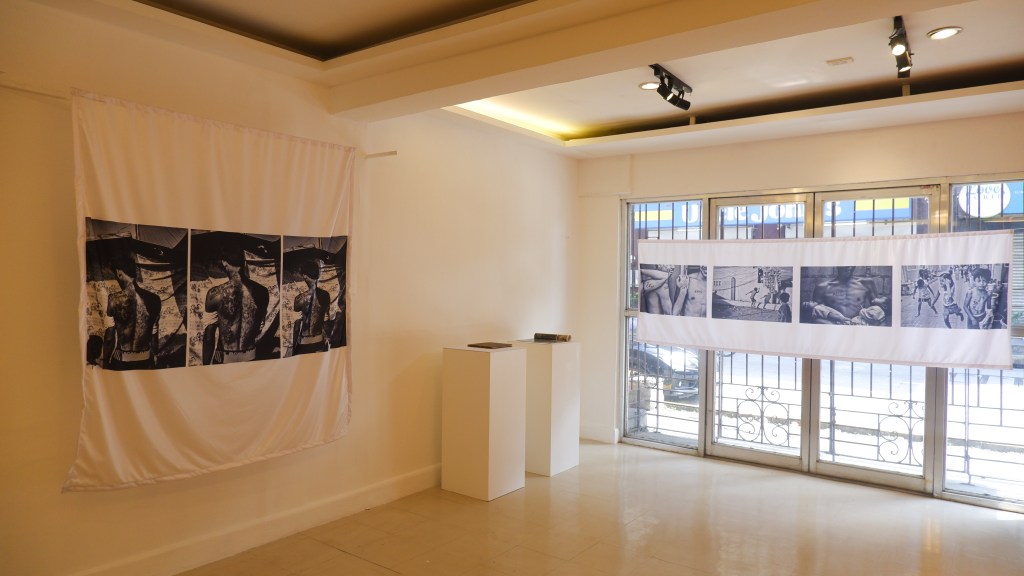
When Villafranca chooses to remain with his subject for years rather than a day–the coverage feels different. The relentlessness of presence, rather than a viral photograph, becomes constantly alive. Beyond the news and archival photographs–leaning toward artistic documentary projects gives Villafranca’s works a continuing space for conversation. Years of photographing a subject means seeing through the changes and persistent issues–refusing to forget is potent in confronting lived narratives. Changing the materials–from photos viewed through doom-scrolling and flipped through in newspapers and magazines into fabric, metal, paper, lenticular boxes, and framed photographs makes complex issues continually present years after the actual coverage.
The exhibition has three sections highlighting Villafranca’s key projects–Marked: Gangs of Baseco, Signos, and Barrio Sagrado. Villafranca’s exploration of photography beyond his photojournalism practice began with Marked: Gangs of Baseco when he received the Ian Parry grant resulting in an exhibition of his project at Getty Gallery in London. Baseco is one of Metro Manila’s most expansive slums. Villafranca immersed himself on site for years, with participants in the project fully aware of who he was and his intentions with the project. Violence, raids, weapons, and drug sessions were unveiled in the photographs, as well as a local embrace of tattooing and hip-hop culture. The images were uncomfortable, the realities known but veiled from the view of the relatively comfortable. Crossing into the fine arts world–the discomfort is palpable, yet it continually makes the discomfort known and felt, rather than buried until it makes the news again.
Signos is a monumental project that documented the typhoons and their aftermath. Disaster coverage is part of the job, as a photojournalist, correspondent, and documentary photographer. It unveiled the realities of a disaster and the significant effects of climate change particularly on vulnerable communities. Yet, after relief operations, discourse often fades away until the next disaster. Signos unpacks the aftermath–what happens in the weeks, months, and years that follow a natural disaster. People look into the immediate–food, clothes, and shelter–but when homes, sources of income, and communities are destroyed, human rights and dignity become even more fragile. Child trafficking, gender-based violence, and the precarity of living become inescapable. Signos documents, and with carefully composed images, confront the viewers with painful and unshakeable truths.
In a room within the exhibition is Villafranca’s Barrio Sagrado, where his personal experiences color and permeate his engagement with the divine and the cultural belief in faith healing. His father, while seeking healing for a critical illness, looked into both clinical and faith healing for relief. For many Filipinos, the belief is complex, with the potency of local beliefs on spirits and their ability to create and heal sickness, coupled with the burdens and costs of clinical approaches encouraging people of less means to seek alternatives. Images for Barrio Sagrado at moments feel more violent compared to his other projects–where desperation and sickness create a visceral sensation in the viewer.
The nature of photography is always shifting. Once imagined to replace painting, it became an art form in its own right. Photograph as a document vis-a-vis photograph as art was once considered a marked divide. Yet, aesthetic considerations and creativity are always part of photographic composition and fine art photography could present sociopolitical issues in a different light. The contemporary moment dissolves formerly formed lines, yet the moment is thickened with the ideas of truths and post-truths. Villafranca’s projects are often ongoing, refusing to close and let go of undeniable truths. He forms and reforms, creates and recreates, continually engaging his subjects and viewers in needed conversations and conditions that must be confronted.
JCB Gallery | Philippine Women’s University | Malate | Manila
Exhibition Run 27 March 27 – 30 May 2025
Opening Reception 27 March | 3 pm
Artist Talk 10 April | 2 pm
Panel Discussion | 2 pm
Exhibition Identity by JL Diquit
Photos by Veejay Villafranca
Installation Shots by JL Diquit
Contact: jcbgallery@pwu.edu.ph
 Portia Placino
Leave a comment