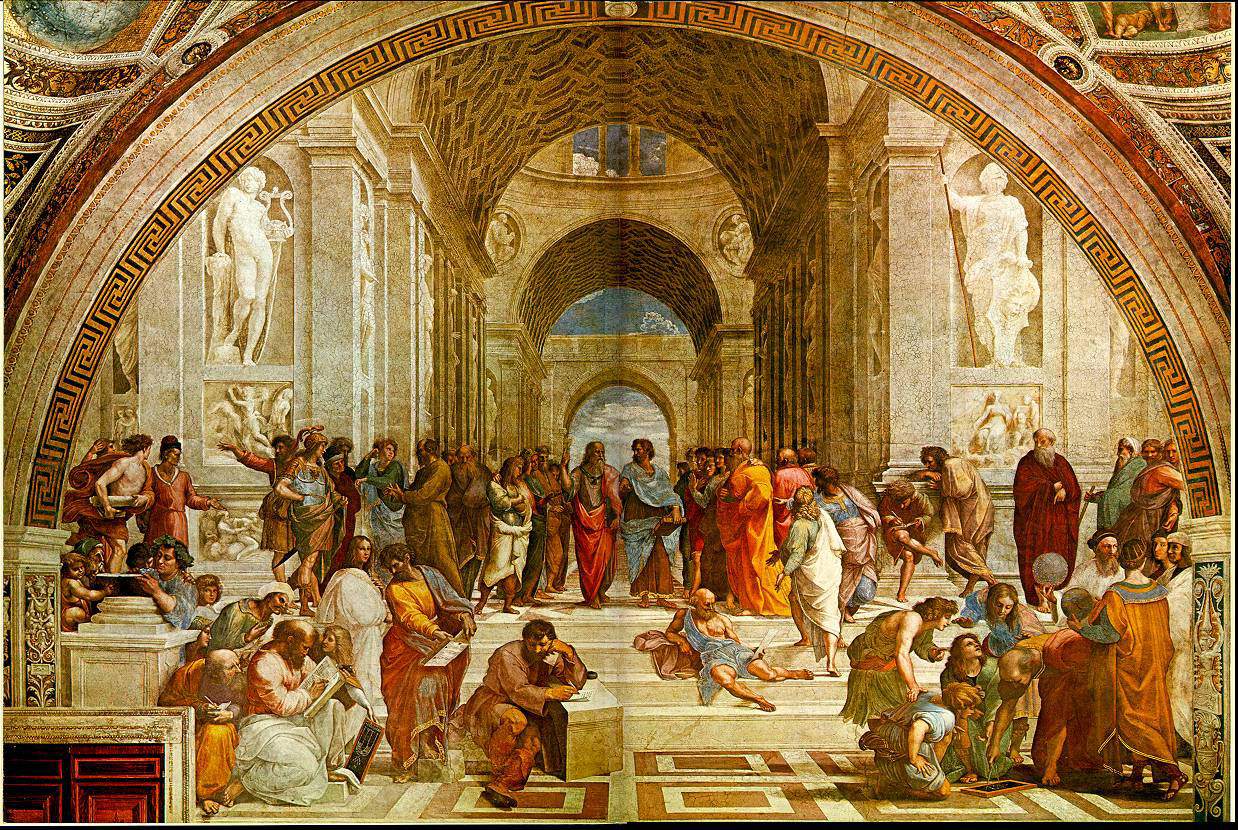
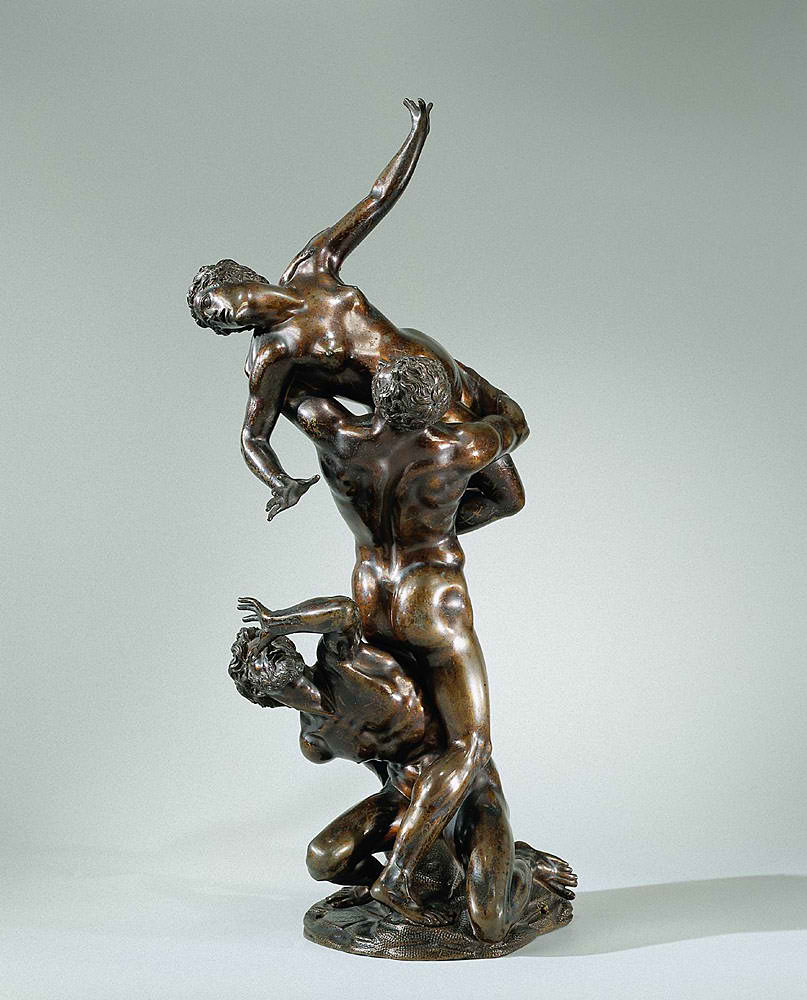
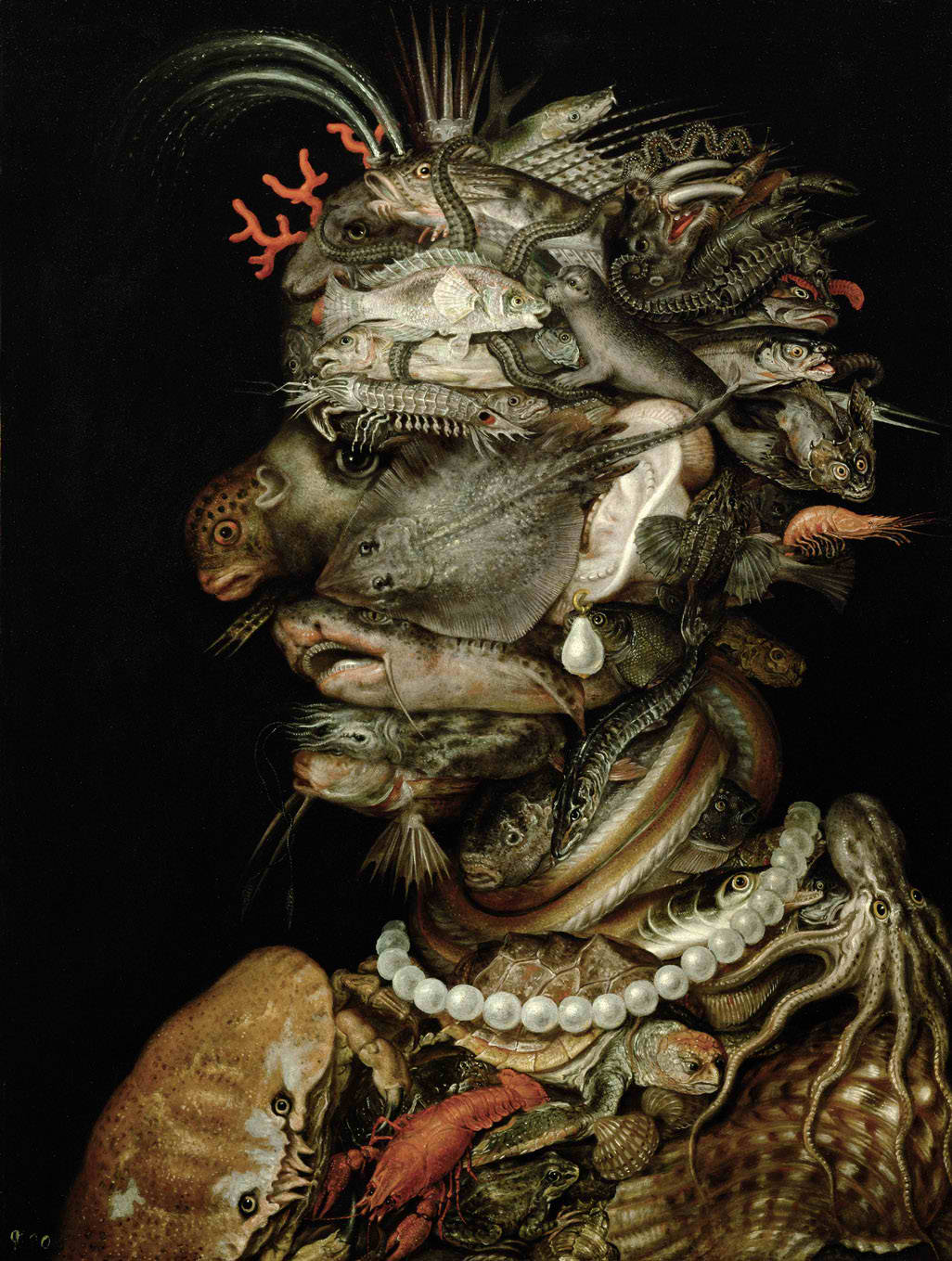
August was full of disruptions, rains, floods, and even illnesses. But hopefully, we leave all that now. As August ends, we also end our lessons in Renaissance. This time, we will explore the High Renaissance into Mannerism. The influence of the state and private individuals heighten, affecting the style and mood of the times.
High Renaissance displays an excellence and height of technique, but with obvious cool and restraint. Mannerism took on the techniques of Renaissance, but exaggerated and contorted it. The social, religious and political upheavals are just beginning here. The twists and turns of the bodies reflects the twists and turns of artistic developments.
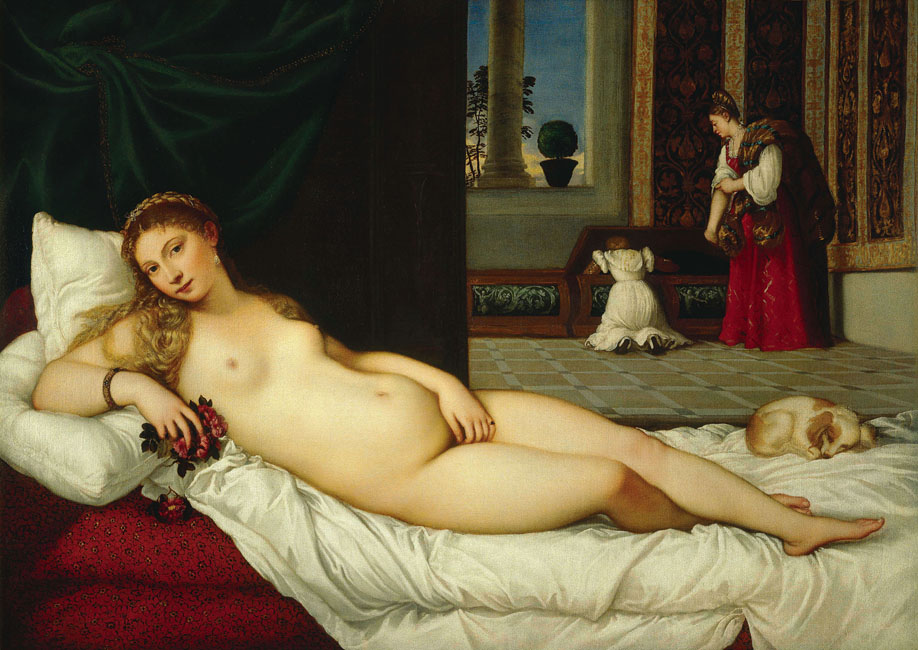
The School of Athens by RaphaelBacchus and Ariadne, TitianAn Allegory with Venus and Cupid, Agnolo BronzinoThe Rape of the Sabines, GiambolognaThe Madonna of the Long Neck, Girolamo FrancescoThe Burial of Count Orgaz, from a Legend of 1323, El GrecoWater, Giuseppe Arcimboldo
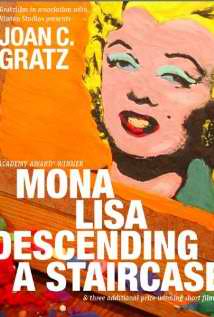
I stumbled into this interesting piece as I was looking for new movies to watch. Since The Artist was such a success, I decided to look for more Academy Award winning films. Watching Mona Lisa Descending a Staircase is a revelation. Youtube people are calling this a 7-minute Art History lesson, specifically, I think this is a 7-minute Introduction to Modern Art History. I can’t wait to show this to my students.
I looked this up further and I saw Joan Gratz’s website. Apparently, she is “An accomplished director, artist, and animator, Joan Gratz pioneered the animation technique known as claypainting.Working with bits of clay she blends colors and etches fine lines to create a seamless flow of images.” The clay painting work for Mona Lisa Descending a Staircase is very impressive. It’s been a while since I saw art as a subject of shorts. I don’t think I’ve seen similar work and technique applied to Philippine cinema. This won the Academy Award in 1992, 20 years ago. But I am yet to see another film technique for the arts such as this one. I can’t believe this is the first time I am seeing this.
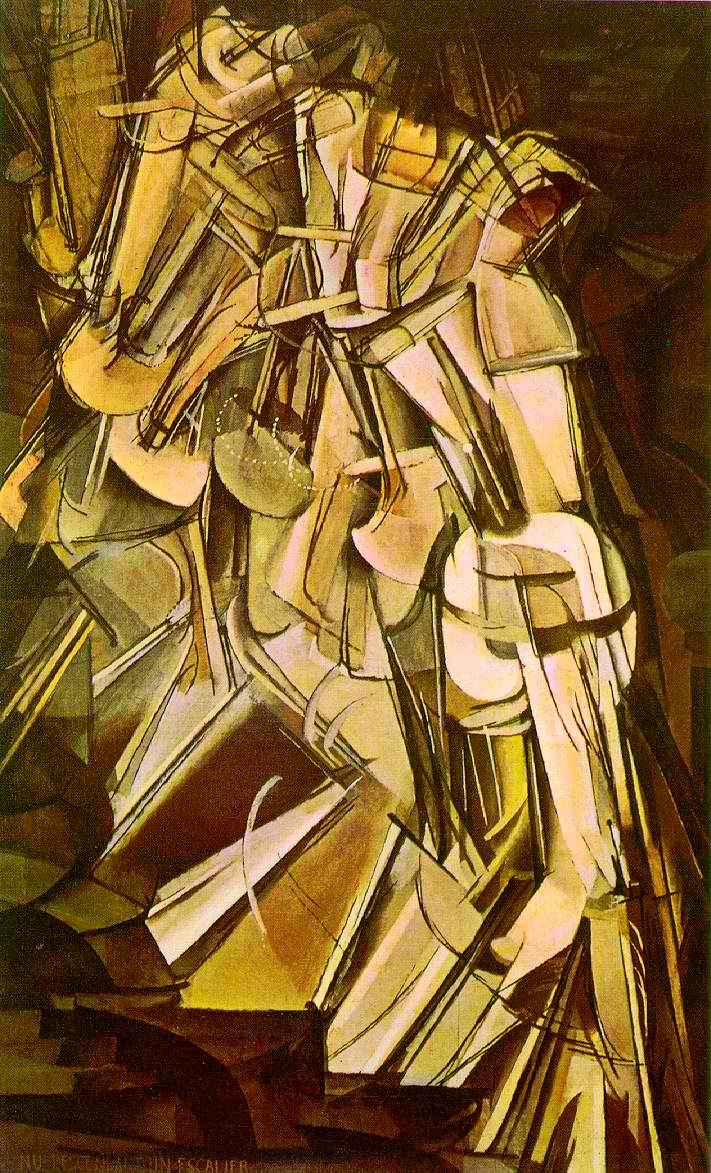
I have seen some complaints in Youtube about the title. Is she looking down on modern art? Where is the staircase? When I first read the title, Marcel Duchamp’s Nude Descending a Staircase first came to mind. After all, it does belong to the same period. Joan Gratz took modern art and told her own story using her own medium. I truly wish there are more works as insightful and as creative as hers. I am now a fan.
Nude Descending a Staircase, Marcel Duchamp, 1912
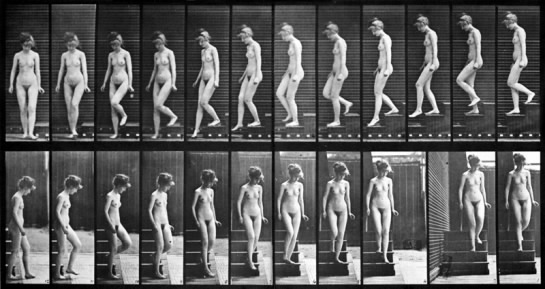
As I dig further, I saw an earlier work, but dealing with motion. Eadward Muybridge, famous for his motion photography (earlier incarnation of motion pictures), also has a work entitled Woman Going Downstairs. This is a very interesting take, placed side by side with Duchamp’s Nude Descending a Staircase.
Woman Walking Downstairs, Eadward Muybridge, 1887
A story of art, indeed, can stand by itself. But it is still interesting to look further, dig deeper. You might learn something new. Today, I did learn. Instead of always looking up, sometimes, you just need to descend and walk downstairs. Its quite an interesting day after all.
Modern ideas are often applied within the aesthetic imagination of the Filipinos. F. Sionil Jose’s obsession with the significant form and the greatness of the art of the masters echoes Clive Bell in his The Aesthetic Hypothesis, “It is the mark of great art that its appeal is universal and eternal. Significant form stands charged with the power to provoke aesthetic emotion in anyone capable of feeling it… Great art remains stable and unobscure because the feelings that it awakens are independent of time and space, because its kingdom is not of this world… The form of art are inexhaustible; but all lead by the same road of aesthetic emotion to the same world of aesthetic ecstasy” (Bell online). Poleteismo, being something which is not covered with such “great art” becomes a subject of controversy and even ridicule of those that remained left in the time and politics of the “great masters”.
The controversy also shows the pre-conception of a bourgeois, educated perspective in the appreciation and critique of art. Isagani Cruz writes in his column, ““Kulo” was clearly too sophisticated for the general Filipino audience. That is proven by the controversy itself. Even the rich and famous who should know better because they have had the chance to visit the largest museums in the world reacted as though they had never travelled. Because they were miseducated, a number of Catholics understandably could not even distinguish between Church and State, art and religion, protest and violence” (online). This echoes the closed and elitist art world that is reflected in Jurgen Habermas, in his Structural Transformation of the Public Sphere, “The bourgeois avant-garde of the educated middle class learned the art of critical-rational public debate through its contact with the “elegant world”. The courtly-noble society, to the extent that modern state apparatus became independent from the monarch’s personal sphere, naturally separated itself, in turn, more and more from the court and became its counterpoise in the town. The “town” was the life center of civil society not only economically; in cultural political contrast to the court, it designated especially an early public sphere in the world of letters whose institutions were the coffee houses, the salons, and the Tischgeselleschaften (table societies)” (1747). It appears that popular critics still believe that there are still the salons and table societies that may house more progressive art forms rather than exposing the general public to such artworks. This elitism and close-mindedness in art discourse fails to enrich the Philippine art discourse and does not address the issue of aesthetics valuation of the Filipinos.
Instead of daring to delve into the aesthetics of conceptual art, art writing in the Philippines are stuck in the ideal, reverting once again to beauty. GWF Hegel’s Philosophy of Fine Arts would become more resonant rather that any exploration or consideration for conceptual art. He says, “Only in the highest art are Idea and presentation truly in conformity with one another, in the sense that the shape given to the Idea is in itself the absolutely true shape, because the content of the Idea which that shape expresses is itself the true and genuine content. Associated with this, as has already been indicated, is the fact that the Idea must be determined in and through itself as a concrete totality, and therefore possess in itself the principle and measure of its particularization and determinacy in external appearance” (Hegel 101). They look into the beauty and truth of an idea of the artwork, rather than its corporeality in everyday life and Philippine society, “For the Idea as such is indeed the absolute truth itself, but the truth only in it’s not yet objectified universality, while the Idea as the beauty of art is the Idea with the nearer qualification of being both essentially individual reality and also an individual configuration of reality destined essentially to embody and reveal the Idea. Accordingly it is here expressed the demand that the Idea and its configuration as a concrete reality shall be made completely adequate to one another. Taken thus, the Idea as reality, shaped in accordance with the Concept of the Idea, is the Ideal” (100). Such an ideal pervades the imagination of art discourse and art practice that unfortunately traps other forms of discourse and practice. There is limited growth in simply searching for the ideal and never even challenging the concept of this ideal that is assigned, even forced into, upon the Filipinos.
The intolerance of varying opinions on art is reminiscent of Immanuel Kant’s The Critique of Judgement wherein the judgement on “taste” is given importance and such concepts were invoked by various critiques published during the controversy. Such elitism of taste is widely invoked by writers and columnists, particularly, again, by F. Sionil Jose as he writes, “Now, let me contribute my two pesos worth in this melee. Bear in mind, I am an octogenarian. I have seen almost every major art museum in the world. I operated one of the earliest art galleries in Manila, Solidaridad, from 1967 to 1977, with the intention of giving our art a Filipino and an Asian face. I am also a novelist, and, as we all know, literature is the noblest of the arts. I am enumerating these not just to establish my bonafides but to show that I know whereof I speak. The exhibit should not have been shown at the CCP. If submitted to my old gallery, I would have rejected it. It is not — I repeat — it is not art! It is an immature and juvenile attempt at caricature. I have not seen the exhibit itself but I have seen pictures of it and they are enough to convince me of the validity of my conclusion” (online). Though there are differences in opinion, published works seeks the agreement of everyone and see the conditioning of “taste”. Kant states that, “The subjective necessity attributed to a judgement of taste is conditioned. The judgement of taste extracts agreement from every one; and a person who describes something as beautiful insists that every one ought to give the object in question his approval and follow suit in describing it as beautiful. The ought in aesthetic judgements, therefore, despite an accordance with all the requisite data for passing judgement, is still only pronounced conditionally. We are suitors for agreement from every one else, because we are fortified with a ground common to all. Further, we would be able to count on this agreement, provided we were always assured of the correct subsumption of the case under that ground as the rule of approval” (Kant 94). Kant also argues that “The necessity of the universal assent that is thought in a judgement of taste, is a subjective necessity which, under the presupposition of a common sense, is represented as objective. In all judgements by which we describe anything as beautiful we tolerate no one else being of a different opinion, and in taking up this position we do not rest out judgement upon concepts, but only on our feeling. Accordingly we introduce this fundamental feeling not as a private feeling, but as a public sense. Now, for this purpose, experience cannot be made the ground of this common sense, for the latter is invoked to justify judgements containing an ‘ought’. The assertion is not that every one will fall in with our judgement, but rather that every one ought to agree with it” (95). This insistence upon the belief of one that should be subscribed to by others is the discourse that is espoused by F. Sionil Jose and those who dealt with the issue. Such matters of taste and those with supposed superior or higher standards of taste is advocated through the popular media as opposed to those who have a limited access upon it.
I looked to the coming of the leap year with dread. It was supposed to be the deadline of my thesis proposal’s first draft. But, maybe the leap year has its magic. Alas, the deadline was extended. With a sigh of relief, I wasted time again.
If you’re a reader of this blog, you will know of my fondness for google doodles. I wanted to write about it during the day, but as it was, I was terribly busy. My voices column went out in The Shakespeare Standard, then spent part of the day procrastinating. It’s an extra day of the year after all, right?
And so it was, it was also the 220th birthday of Gioachino Rossini. Unfamiliar with his music? You’re not. Listen to this…
The things we learn everyday, right? Gives us some Loony Tunes and Lone Rangers memories. I was reading comments on YouTube, saying that if Rossini was alive, he’d be so rich because of all the royalties due him. They’re right, of course. It’s probably why older, popular cartoons choose “classic” music instead of contemporary ones. Not that I’m saying it’s a bad thing. At least children of the generation are familiar with the music and are regularly exposed to it. Nowadays, sigh…
Who didn’t have cowboy fantasies? Especially after listening to that? And of course, in another incarnation, is Mickey Mouse! As I said, it’s very educational and helpful for children to listen to such music. I grew up with it. It makes me sad that children today rarely see this. It’s just one spectacle after another today.
Going back to Rossini, he’s also the composer of The Barber of Seville. Yes, you are familiar with that. It’s the first part of The Marriage of Figaro trilogy. Yes, it’s good with cartoons too. I only wish we could still be as cultured as before. Even cartoons were thinking cartoons. We were geeks without even knowing it.
As revealed in the discussions on Poleteismo, Filipino people are still looking for beauty in art. Numerous articles are looking, not just for beauty but also for the ennoblement of the soul. It almost appears that the Filipino aesthetic valuation and theory remain still with the “great masters” echoed by F. Sionil Jose. In another article by Isagani Cruz, he states that, “Instead of ennobling some Catholics, “Poleteismo” made them commit one of the deadly sins — anger. It made them receive Holy Communion with hatred in their hearts — the sin of sacrilege. It made them judge and therefore made them liable to be judged. It made them throw the first stone even if — let us not be hypocritical — no human beings except Jesus and His mother Mary were born without sin. There is provoking and there is provoking. The kind of provoking that Mideo Cruz did was not justified by the creative piece that he did. Critics always say that an artist should “earn” the effect of his or her work. That means that there should be a deliberate, successful effort by the artist to achieve whatever it is she or he wants to achieve. No art piece can be conceived simply on the spur of the moment. Every art piece that aspires to be art is always the product of long, careful, profound hard work. Therefore, based on the reception of the work, “Poleteismo” flunked the test of good art. It may be art, but it is bad art. It may be art, but it is not Art” (online). This kind of discourse becomes the popular and the norm for the Filipinos, which ironically, echoes some of the earliest aesthetic discourses. Plotinus, in his Ennead One: Sixth Tractate, echoes the same sentiment, “Such should be the experience of beauty, amazement, pleasant consternation, yearning, ardour, and excitement mixed with pleasure” (50). Such belief is also reflected by Francis Hutcheson in An Inquiry into the Origin of Our Ideas of Beauty and Virtue, “Our sense of beauty seems designed to give us positive pleasure, but not positive pain or disgust” (97). These are early philosophies of aesthetics that are subscribed to by the popular writers and are therefore what most Filipinos are exposed to.
Looking back, one of the earliest theories on beauty is that of the Greeks. Their understanding of beauty focuses on the “1. wonderful and supreme; 2. as beyond all measures and distinctions, related to un-limit; 3. as pertaining to all things; 4. as pertaining to the gods and to nature and natural things as well as to human beings and their works, including works of art; 5. as pertaining to finite things, shapes, colors, sounds, thoughts, customs, characters, and laws; and 6. as inseparable from goodness and excellence (arete)” (Ross in Oxford 238). There appears to be a limited understanding of beauty as well as the canons of art in the aesthetic understanding of the Philippines. It is widely believed that there is a standard of beauty and a specific canon that should be followed for art to be considered as art. There is, not only a canon for beauty but also a canon on how art should be perceived. Silvers writes, “Canonical objects accomplish this not by modeling how other works should look (each should be unique) but instead by modeling how we should look at other works; that is, the eye or ear or sensibility of the prospective connoisseur is cultivated by exposure to art that the admiration of previous generations of connoisseurs has marked as canonical (Oxford 335). This kind of perspective was perhaps part of what inspired F. Sionil Jose in citing his experiences of seeing the works of great masters from great museums that make him an expert on judging the work as something which is not art. The discernment from a photograph is enough for him to determine that he can actually do the work and therefore declare that it is not art. Again, as this is a word by a National Artist, it pertains to a canonical valuation as well as a canonical perspective on beauty.
On judging beauty, David Hume’s Standard of Taste should be looked into. He says that, “It is well-known, that in all questions, submitted to the understanding, prejudice is destructive of sound judgement, and perverts all operations of the intellectual faculties: It no less contrary to good taste; nor has it less influence to corrupt the sentiment of beauty (Hume 494). Ironically, Hume also points out that not everyone can properly judge artworks as they may be lacking in their taste. He further states that, “Thus, though the principles of taste be universal, and nearly if not entirely the same in all men; yet few are qualified to give judgement on any work of art, or establish their own sentiment as the standard of beauty. The organs of internal sensation are seldom so perfect as to allow the general principles their full play, and produce a feeling correspondent to those principles” (494). The belief that there are standards to be followed and that not everyone is capable of having or discerning that standard is prevalent among the Filipino popular writers. For F. Sionil Jose and the others, it is the great masters of the art world that are the standards of beauty and greatness of artworks. Again, as F. Sionil Jose writes, “First, what is art? I go by this simple definition: Being an artist myself although I work with words not with the brush — if I can do it, it is not art. If I were to do the Jesus Christ commentary in oil, I would have used imagination, craftsmanship, and most important — originality. None of these basic qualities are in the CCP exhibit” (online). There is a canon of the medium–the oil, and not only that, but also the canon of looking at and examining the medium. Though there is a welcoming online discourse on the matter, it is still those with a larger voice that is given the larger space to express their views, as in the case of columnists and editors; more than the ordinary netizen or even the academics and theoreticians.
There is also the pervading belief that art should be pleasurable because of its beauty. Perhaps it is where aesthetic education of the Filipinos today came from and eventually got stuck there. Friedrich Von Schiller in his essay On the Aesthetic Education of Man, he states that, “For whole centuries thinkers and artists will do their best to submerge truth and beauty in the depths of a degraded humanity; it is they themselves who are drowned there, while truth and beauty, with their own indestructible vitality struggle triumphantly to the surface” (Schiller 580). The Cultural Center of the Philippines is still stuck in “The true, the good and the beautiful” that the aesthetic education of Filipinos became stunted in its growth. The Imeldification that struck CCP from its founding in 1969 until the present day was never truly replaced. Risqué, challenging and confrontational artworks that do not fit “the true, the good and the beautiful” suffers. The publicity received from the Imelda visit and her comments on KKK (Katotohanan, Kabutihan at Kagandahan) struck a nerve, not just on the artworld but on the Filipino public. Once again, this woman was listened to, especially as newspapers, such as Inquirer and Sun credits her for the closing of the exhibition. This discourse on beauty is traumatized and afraid of disgust and merely looks into pleasure. These valuation is where the aesthetic value of the Filipinos, even the institutions got trapped in. It is a good philosophy to a certain extent, but far too narrow and limited. It may apply more to the 19th century Filipino oil paintings but hardly to conceptual and popular art that numerous artists are exploring in the present time. Contemporary context of art will hardly apply to the concept of “the true, the good and the beautiful.”
In the discourse of beauty and the sublime, the sublime was hardly looked into within the popular discourse. Mideo Cruz’s Poleteismo would fit more into the theory and aesthetics of the sublime, rather than the concept of beauty that was insisted upon by the popular media. Guy Sircello in Is a Theory of the Sublime Possible? poses the possibilities of the sublime discourse that might also be useful in the discourse of Poleteismo. He first distinguishes the tripartite aspect on the issue of the sublime, “first, there are experiences of the sublime or alternatively, sublime experiences. Second, there is what I call the sublime discourse. And third, there is talk about the sublime (Sircello 541). In this context, he poses some assumptions, “The first assumption is that only sublime experience properly motivates sublime discourse and therefore that only sublime experience is the proper and ultimate subject matter of talk about the sublime” and “My second assumption is that sublime experience can and does occur in a large variety of personal, cultural, social and historical contexts, all such contexts also inevitably involving experience that is not specifically sublime” (542). He formulated a theme on the sublime which he refers to as an “epistemological transcendence” (542) that is supposed to validate a sublime discourse that can somewhat be quantified without falling into the trap of universalism. Despite this attempt, there are still various topics that needs further exploration, “(1) what it might mean, (2) whether it is indeed presented in sublime experiences, (3) what, if so, there might be about such experience that could present an epistemological transcendence of that form, and finally, (4) whether epistemological transcendence as so interpreted is warrantable or believable are tasks–among many other tasks–at least for more talk about the sublime, if not for a theory of the sublime. This exploration of the subliminal discourse will be much useful in Mideo Cruz’s work, particularly in the experience, discourse and talk that the artwork and the surrounding controversies inspired.
Part III of Art Conversations. I am working on this topic. I am posting it here, hoping for a response from those who wants to engage in this conversation.
Since I started teaching in an exclusive school, I became fond of starting the semester with Mona Lisa Smile. This line from Catherine Watson is the best:
What is art? What makes it good or bad? And who decides?
It is one of the key things that I try to teach in an Art Appreciation class. Even in an Art Historyclass. How do I convince my students to ponder about these things? I always want my students to challenge not just the role and image of art but also of their place as women in society. We have come a long way since the setting of the movie (50s), but let’s face it, women today are still expected to marry and have children after they graduate. Not that they shouldn’t, but, it should not be to their detriment if they do not want to. Of course, the weakness of the movie is on Catherine Watson’s own love story, which is completely unnecessary to the narrative. But, this is still Hollywood cinema, it is inevitable.
The issues presented in the movie is still relevant in the contemporary setting. When asked about artists that they are familiar with, it is still very common to hear about Leonardo da Vinci and Michelangelo. After all these time, few would immediately name Soutine or Pollock, the artists featured in the movie. Abstract expressionism, is well, still abstract in their mind. It is the consideration for art that they need to learn. There are various artistic movements that is difficult to trim it down to a two-hour class every week for the entire semester.
Carcass, SoutineNumber 1, Pollock
Part of the responsibility of a teacher is to choose what to teach to their students. It is the most difficult part. There are too many artists, art works and art movements that choosing what you teach in class can be quite a burden. How do you mold your lesson, not just to teach, but to be relevant to the lives of students. As part of the educational institution and of the artworld, the teacher defines what is art. It is inevitable based on what you teach and what you put up for consideration for your students. The strength of the institutional theory of art is strongest in the classroom.
Another issue covered by the film is the mass reproduction of art. Remembering Walter Benjamin’s Art in the Age of Mechanical Reproduction, one should consider the effect of mass production in art. Decades after this article is written, it is still very relevant, even more in todays setting. With Tumblr and other photo sites, reproducibility is more rampant now than ever. Does this affect the production of art? Or the appreciation of it? Or does it depreciate the value of art? I have never been to Europe or America, so at least I can experience their art through these reproductions, but, it is not the same. But different is not necessarily worse. For one thing, I am able to teach my students based on these reproductions.
Sunflower, Van Gogh
Lastly, another issue dealt with by the movie is on advertisements. Last semester, I covered advertisements, especially with the issue on the gigantic Bench advertisements along EDSA featuring the Azkals. The imagery of men and women in advertisements and the reactions the inspire from the audience is very different. Just like in Catherine Watson’s breakdown, how will the future scholars see us and represent us? Unfortunately, I have to say that even my students love the photo of the MAC cosmetics and would be pleased to look like Barbie dolls. We still have a long way to go.
Ironically, a film about women’s role in the artworld ignores women artists. The film still falls in the trap of art HIStory. But that would be part of another lesson, another time. A very lengthy lesson.
Self-Portrait, Frida Kahlo
This is just the beginning of an exciting semester. Hopefully, it will be a good one. In the end it is still about choices. After this course, maybe art can play a role in those choices. It is the smiles and frowns of a Mona Lisa.
Soft lighting, generic jazz music, cheap wine, flowing beer, canapés, dimsum, finger foods and pretensions—that pretty much describes the stereotypical gallery opening in the “modern” art world of Manila. People laugh, smoke, kiss each other’s cheeks and throw in art words as they toast to the success of the exhibiting artist and gallery. They are the connoisseurs, artists, gallery staff, collectors and critics. They are deemed “experts” in the artistic field—the avant-garde.
How can one fully appreciate the avant-garde of Manila’s art? Charles Baudelaire described the perfect audience of modern art—the flâneur, “The crowd is his element, as the air is that of birds and water of fishes. His passion and his profession are to become one flesh with the crowd. For the perfect flâneur, for the passionate spectator, it is an immense joy to set up house in the heart of the multitude, amid the ebb and flow of movement, in the midst of the fugitive and the infinite. To be away from home and yet to feel oneself everywhere at home; to see the world, to be at the centre of the world yet to remain hidden from the world—such are few of the slightest pleasure of those independent, passionate, impartial natures which the tongue can clumsily define. The spectator is a prince who everywhere rejoices in his incognito” (Baudelaire 795). Maybe one does indeed need to embody the French flâneur, in order to bear with the avant-garde.
The Son of Man by Rene Magritte
A work regarded as avant-garde is something good, great even. It is the new and chic in the art circle. One often hears of this artist or that is really avant-garde and is quite popular and celebrated. These artists are the new and the modern artists. Endless small talk among the popular experts would continue for about three to four hours. If you would actually listen though, among the clinking glasses and swishing beers, you would be left in a wide-eyed wonder at what everyone is actually talking about. Through the eyes of the flâneur, this scenario might’ve been much better. For an idler that could independently wander around through endless parties, belonging yet remaining hidden, perhaps the flâneur would enjoy gallivanting through this crowd.
It will not be surprising that such a circle would not have read Clement Greenberg’s Avant-Garde and Kitsch written as early as 1939. He cites the pre-eminence of the avant-garde because of its “superior consciousness of history” and its purity as “art for art’s sake” (Greenberg 2). You can stare and listen for hours, wondering if they are aware of how old the concepts they were talking about are. Given the flâneur’s luxury of time, perhaps a flâneur would’ve read Greenberg and would be able to articulate on the avant-garde much better in this crowd. One would wonder, though, would the flâneur be as aware and as conscious of what modernism really is and where the concept came from?
Would the flâneur have the time to read on history and philosophy or would parties and gallery exhibits mostly occupy such luxury of time? Would he encounter the fact that the newness of the modern started out as early as the mid-1500s when the break between the accepted dogmas of the church surfaced upon the scientific findings of the Copernican Theory? That the dogmas were declared wrong and the man is proven correct? This concept would later be refined by Galileo and Kepler in the 1700s. Ecclesiastical authority declined as the man discovered his own authority over the environment. The power of the man is slowly recognized until such time that a man is considered as the creator and discoverer rather than being a subject of a creator. By the time the Renaissance came into being and classical knowledge were re-discovered, religious dogmas were relegated as the myths of the “dark ages” (Russell 491-495). Can the flâneur take some time off from the socialization and go in-depth in the concept of modernism that created the very nature of a flâneur?
Thinking about is, would a flâneur go to church? Or perhaps feel how it’s like to be trapped within a belief of one? Emancipation from the church gave rise to the individualism. The role of the individual increased and was freed from the collective as the church followers and followers of god (493). By the time Greenberg wrote his article, the individualization and specialization of the artist is no longer a new concept, but a concept a few hundred of years old (Greenberg 4). Contrary to pretentious belief, the modern individuality of an artist is not an invention of the present but something that has been written about in 1939 and was developed as early as the Renaissance. I then wonder how some artists would feel, declaring themselves as modern artists, if they are made aware of these concepts. Will the flâneur know how old the concept espoused by the nature of his own individual existence?
Ironically, though modern thought and philosophy started with breaking away from religious dogmas and doctrines, modernists still went back to these debunked concepts to explain modern art. Greenberg cites the imitation of God in the dissolution of content and the sole focus on the forms (2-3). This type of thought would persist as the form and even colour is viewed as the resonance of the spirit such as in Wassily Kandinsky’s Concerning the Spiritual in Art. Though the break in the philosophical thought was significant, it eventually came into full circle as modernists went back to religiosity, spirituality and godliness in their philosophies. Again, I begin to wonder how the art circle would accept a reading of the avant-garde modern paintings they market into something akin to Kandinsky, that the blue is restful and a heavenly colour and that it has profound meaning in its retreat from the spectator. I also remember a work of Joya in the Ateneo Gallery, a white and yellow painting. In the Kandinsky analysis, the white is the harmony of silence and the absence of colour while the yellow, as typically earthly colour, is a sickly colour that can never have any profound meaning (Kandinsky 27-45). Such thought process is still difficult to reconcile to modern philosophy of breaking away from religious dogmas that has ruled over art production before modernism. Can the flâneur, exposed merely to bourgeois society, understand the irony and implication of spirituality in modern art?
The Man of the Crowd (based on Edgar Allan Poe) by Brian Pedley
The flâneur belongs to society, particularly, the bourgeois society, wherein they drink in and experience the pleasures of art. The more prevalent modernist perspective among the appetizer guzzling, alcohol gulping and social climbing is the experiential aspect of artworks that is a very modern perspective. Modern in the period of modernism, certainly, but looking at their perspective today, it is very different. In 1914, Clive Bell wrote that, “Without sensibility a man can have no aesthetic experience, and, obviously, theories not based on broad and deep aesthetic experience are worthless. Only those for whom art is a constant source of passionate emotion can possess the data from which profitable theories may be deduced; but to deduce profitable theories even from accurate data involves a certain amount of brain-work, and, unfortunately, robust intellects and delicate sensibilities are not inseparable. As often as not, the hardest thinkers have had no aesthetic experience whatever” (7). They talk of experience without thought, yet nowadays, we all know that everything—even matters of the “heart,” are actually processed by the mind. Such processing of experience from “significant forms” without consideration for content is still a mental and an intellectual practice. Of course the quality and depth of such practice will vary from the halls of the academe to magazines and even to cocktail receptions of the art circles. Which perspective will the flâneur prescribe to?
The flâneur hopefully, might be able to open a book once in a while. Maybe then, the flâneur may be forced to face a concept that goes against his existence. One wonders which would prevail in this confrontation. The art crowd would do well to do a little bit of reading, particularly, John Dewey’s Art as Experience. Before spouting “art as experience” in between munching canapés or some strange pesto on supermarket bought French bread, they should pick up a chapter or two instead. They might realize what they have done, “So extensive and subtly pervasive are the ideas that set Art upon a remote pedestal, that many a person would be repelled rather than pleased if told that he enjoyed his casual recreations, in part at least, because of their esthetic quality” (Dewey 5). Art is not meant to be separated, relegated to museums and galleries, surrounded by petit-bourgeois and inaccessible to the live creature or the ordinary human beings. Dewey further states that:
“The existence of art is the concrete proof of what has just been stated abstractly. It is proof that man uses materials and energies of nature with intent to expand his own life, and that he does so in accord with the structure of his organism—brain, sense-organs, and muscular system. Art is the living and concrete proof that man is capable of restoring consciously, and thus on the plane of meaning, the union of sense, need, impulse and action characteristic of the live creature. The intervention of consciousness adds regulation, power of selection, and redisposition. Thus it varies the arts in ways without end. But its intervention also leads in time to the idea of art as a conscious idea—the greatest intellectual achievement in the history of humanity” (25).
Though Dewey opened up the art experience to the living creature, much of the art circle still subscribes to the Baudelaire’s concept of the flâneur. This flâneur would converse and mingle in the art crowd, in search for modernity, as Baudelaire would describe him, “Be very sure that this man, such as I have depicted him—this solitary, gifted with an active imagination, ceaselessly journeying across the great human desert—has an aim loftier than that of a mere flâneur, an aim more general; something other than the fugitive pleasure of circumstance. He is looking for that quality which you must allow me to call ‘modernity’; for I know of no better word to express the idea I have in mind. He makes his business to extract from fashion whatever element it may contain of poetry within history, to distill the eternal from the transitory” (798). So many still subscribe to this concept, forgetting that it is a bourgeois “man” created and conceptualized to appreciate modern art in its “art for art’s sake” realm. To experience and appreciate art, does one really have to subscribe to the demands of the “modern”, does one have to be a flâneur and kiss one another’s cheek in the formation of an art discourse? This concept would shock the flâneur and might question the very foundation of his modernity.
Perhaps, it is true that the art circles have not escaped from the modern trappings. They do not realize that this new modernism is actually old, that when they are trying to be avant-garde, they are actually moving backwards and that when they are trying to be flâneurs, they are trying to be bourgeois male of many decades past. Jürgen Habermas, in his Structural Transformation of the Public Sphere states that, “The bourgeois avant-garde of the educated middle class learned the art of critical-rational public debate through its contact with the “elegant world.” This courtly-noble society, to the extent that modern state apparatus became independent from the monarch’s personal sphere, naturally separated itself, in turn, more and more from the court and became its counterpoise in the town. The “town” was the life center of civil society not only economically; in cultural-political contrast to the court, it designated especially an early public sphere in the world of letters whose institutions were the coffee houses, the salons, and the Tischgesellschaften (table societies)” (1747). The more today’s artists, curators, gallery workers and collectors insist upon avant-garde(ness) and modernism, they are not moving forward, they are not even staying still, they are moving backwards, further and further back into art history.
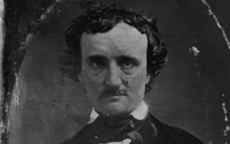
Edgar Allan Poe's Daguerreotype
Going back to the flâneur, himself an imagination of decades past, as early as Edgar Allan Poe’s The Man of the Crowd, and even Jean de la Bruyère’s The Characters, is neither a new concept nor a unique one. The perspective of a bourgeois middle-class man should be let go of the art world, more importantly, they should let go of the false belief that this is of their own creation in the contemporary world. Modernism is old, so is the avant-garde, so it is about time that the art world should stop trying to be flâneurs. They cannot live as the flâneur lived, nor should they try to, “In the window of a coffee-house there sits a convalescent, pleasurably absorbed in gazing at the crowd, and mingling, through the medium of thought, in the turmoil of thought that surrounds him” (Baudelaire 794). Though experience, pleasure and modernism have a place in the art world, it shouldn’t be the central concepts that drives it. For one thing, we are not all men. Independent bourgeois hardly ever exists anymore as most of us have to work for a living as well. We are no longer concerned with “art for art’s sake,” instead, we are engaging in an art discourse.
READ. Soft lighting, generic jazz music, cheap wine, flowing beer, canapés, dimsum, finger foods and pretensions—before falling into this trap, READ. We should stop being flâneurs looking at “art for art’s sake.” Instead, read, study and understand before spouting avant-garde and going backwards, falling into the trap of modernism and Tischgesellschaften. After all, it’s the kitsch that had more success in the long run. It’s the popular image that we live in today. It’s the iconic effigies that are burned in rallies and assemblies. It’s how we got our democracy back. We should live in the present. It’s about time that the art circle grows up and moves on. Before wine sipping and beer guzzling on show openings, opening a chapter or two of theoretical books cannot hurt; after all, it’s the terminologies that they are so fond of using. Though the trappings of modernism are not easy to escape from, we should at least start to. We should accept that we are not, nor we will ever be flâneurs. We don’t have Tischgesellschaften. We have a lot of discourse available to us, we should start discussing topic relevant to the contemporary world that would develop, not hinder art development and maturity.
Works Cited
Baudelaire, Charles. “The Painter of Modern Life.” Leitch, Vincent. Norton Anthology of Theory and Criticism. New York: W. W. Norton, 2001. 792-802.
Bell, Clive. Art. New York: Frederick Stokes, 1917.
Dewey, John. Art as Experience. New York: Penguin Books, 1934.
Greenberg, Clement. “Avant-Garde and Kitsch.” Partisan Review (1939).
Habermas, Jurgen. “Structural Transformation of the Public Sphere.” Leitch, Vincent. Norton Anthology of Theory and Criticism. New York: W.W. Norton, 2001. 1745-1758.
Kandinsky, Wassily. Concerning the Spiritual in Art. New York: Dover Publications, 1977.
Russell, Bertrand. History of Western Philosophy. New York: Simon and Schuster, 1972.
Performativity in Aesthetics and Theoretical Practices
by: Maria Portia Olenka C. Placino
“Artworks must be conceived not as products (decontextualized or contextualized) of generative performances, but as PERFORMANCE THEMSELVES.”
Image via Wikipedia
Art as Performance by David Davies is a challenging book that uses philosophical and logical approaches towards aesthetic practices. His main thesis, as stated above, points out that artworks are not simply products of performance, rather it is a performance in itself. Though he applies his theory in earlier works, the book mainly creates an aesthetic and theoretical framework that accomodates late modern works and beyond. An artwork is not viewed as a product of an artist’s creativity, rather, an artwork is viewed as a process completed by the product. Davies’ theory is a good starting point in the study of the emerging trend of performativity in aesthetics and other art practices such art art criticism.
Davies questions the accepted form of art theory which he refers to as the common-sense theory. In the common sense theory, the instances of works and a direct experiential encounter is necessary as it is an intrinsically valuable experience. This perspective also views artworks as artifacts with aesthetic value conferred by their creator. To counter this, Davies uses Marcel Duchamp‘s The Fountain. This late modern work creates a new perpective in art history, art theory, aesthetics and art criticism. To view The Fountain formally through its form, color, line, proportion, etc., would be missing the point of The Fountain. A person may not have the direct experiential encounter with the work, yet the meaning and the point of the work may still be understood. The Fountain creates a shift in the way that artworks may be viewed, experienced, critiqued, and theorized. Perceiving The Fountain as a performance makes more sense rather than viewing it formally as a generative product of artistic creativity.
Common-sense theory is attacked by Davies in its three fronts, common-sense axiology, common-sense epistemology and common-sense onthology. Axiology deals mainly with value or a valuation of art work while epistemology deals with the knowledge and definition of an artwork and onthology deals with the nature of an artwork. These three fronts of the common-sense theory are completely altered upon the introduction of late modern works particularly of Duchamp’s The Fountain. The long established system of valuation, definition and nature of an artwork is no longer applicable to the contemporary works introduced. Because of this, Davies’ performance theory comes into play as it accomodates the works that is outside of the common sense theory.
Performance Theory states that “artworks are performances, more specifically, they belong to the class of performances whereby a content is articulated through a vehicle on the basis of shared understandings.” This perspective diverges from common-sense axiology, epistemology and ontology. Going back to Marcel Duchamp’s The Fountain, in terms of common-sense axiology, its artistic, economic and art-historical value is very different as compared to Pierro dela Francesca’s The Baptism of Christ. Looking at the material, it is an ordinary urinal, so it will not have a high economic value. In terms of artistic value, it is a bought object, Duchamp did not make it or sculpt it, so in the common-sense axiology, it also has no artistic value. In terms of art-historical value, maybe it does have a high value, because it changed the way artworks are to be viewed and perceived, yet it will not meet the formalistic sense of an art-historical value in the same way as the academic, historical, allegorical or religious paintings and sculptures. It is in the performativity of the art work that a value is established.
Examining the epistemology of art in the performace theory, art is a performance rather than a product of a performance. The production and the product is as one, it is perceived as a process rather than an end in and of itself. The immediate and direct experiential encounter with the work is not necessary in the appreciation or the understanding of an artwork. Rather, it is conceived of as a performance which expresses its thought and meaning even without a direct experiential encounter, an encounter which common sense theory finds necessary for an artwork to be understood and appreciated. The artistic genius is not a mystical entity, rather, it is a product of a group consciousness that is shared by human beings. Though it is the artist that makes an artwork, the consciousness wherein that artwork comes from and where that artwork is formed, is a group consciousness, not a mystical and individualized artistic genius. Once again, this is a significant shift upon how an artwork is defined and conceptualized.
Another shift happens with the ontology of art or the way that the nature of art is understood. Davies states that, “Artworks, come to existence through the intentional manipulations of a vehicular medium. Through these manipulations, artistic statement is articulated in virtue of shared understandings as to how those manipulations are to be characterized in the vocabulary of an artistic medium, and as to the import of particular manipulations characterized.” The ontological shift made by Davies is significant because it lays the foundation of the premise of performance theory, wherein art, from being a product of a performance of the artist, becomes an actual performance. The object became a completion of the performance rather than just being a product. This is a radical divergence from the way the nature of art is understood in the common-sense ontology wherein the object is simply a generative product. There is a drastic shift in the way the nature of art is understood with Davies’ performance theory.
Such shifts introduced by Davies is significant in contemporary art theory and criticism. The weaknesses of his arguments comes from his philosophical and logical styles. Though such manner is effective in philosophy and logic, aesthetics and art theory still needs to go back to the artwork. Leaving the artwork too far behind while the theory or argument is being pursued depreciates the merit of the argument presented. Furthermore, aesthetics and art theory still needs some material basis in an artwork conceivable by people, particularly in the contemporary times. Theorizing an artwork as it would have been produced and consumed in Mars, a twin Earth or another galaxy is too far off a person’s experience that the argument becomes too abstract. Aesthetics and art theory cannot be simply deduced into a formula. For at least in the present time, there should still be an actual artwork (or an actual performance according to Davies) that is referred to by aesthetics, art theory, art history and art criticism. An artwork or performance outside the experience and understanding of an ordinary human being (such as the supposed artworks in Mars, twin Earth, another galaxy) does not make sense in the practices of aesthetics, art theory, art history and art criticism. Davies himself states that group consciousness come into play in the performance, understanding and appreciation of such works, if a consciousness too far removed from human experienced is factored in, then the argument fails in its merit.
Davies considers jazz improvisation as an excellent example of a pure performance work. The pure performance of a jazz improvisation fits well into his performance theory. Yet, the premise in jazz improvisation is that it is spontaneous and unplanned. There are various complications that can arise in this argument, for instance, what if the jazz improvisation performance is recorded, reproduced and repeatedly played, is it still a pure performance work? Would that recording played over and over again still be a pure performance work that is theorized by the performance theory? Or does it become part of performed works that can belong to the conception of a common-sense theory? Such arguments need reconsideration. Some of Davies’ claims, though valid, are more easily explained through theoretical and philosophical examples rather than by artworks in the real world.
In art practices, performance theory is best applied to art criticism. As a growing trend in the art critical practice, more papers are written not just on the art object or artwork but more critics are looking into the performative aspect of an artwork. Such writing utilizes performance theories such as that of Davies’. Though Davies’ performance theory is well-developed in his writing, it still needs to go back to the artwork itself and be more understandable to the existing artworks of the world, rather than being understandable towards an artwork in another world or universe. The theory needs to be applied more effectively on existing artworks of this world and the art world rather than spending so much time theorizing on other galaxies and planets with different system of valuations, epistemologies and ontologies.
Performance theory paves the way of accomodating late modern works and beyond in the aesthetics, art theory and art criticism practices. Though the argument style of Davies may have lacks and glitches, it ushers in the contemporary artworks into theoretical practices that would have been impossible within the formalistic, empiricist and common-sense theory. This is very important as it can bridge the gap between contemporary art and earlier artworks because the performance theory may be applied to both of them. This more detailed take on family resemblances on the relationship of artworks as a performance rather than a generative product of a performance offers a new way that artworks may be understood, accepted and appreciated into an ever-changing world, particularly the art world.
Work Cited:
Davies, David. Art as Performance. Malden, MA: Blackwell Pub., 2004. Print.














 Portia Placino