Contradictions. What can you expect when you merge street music and Shakespeare? Do you even consider it? What I discover is that there are gems in contradictions. My friend (Cyrus) and I should know. We arrived in style (so to speak)–a rusty tricycle ride to a clean, white and elegant facade of PETA Theater in New Manila, filled with nice cars no less. But no matter, the adventure of contradictions thus began.
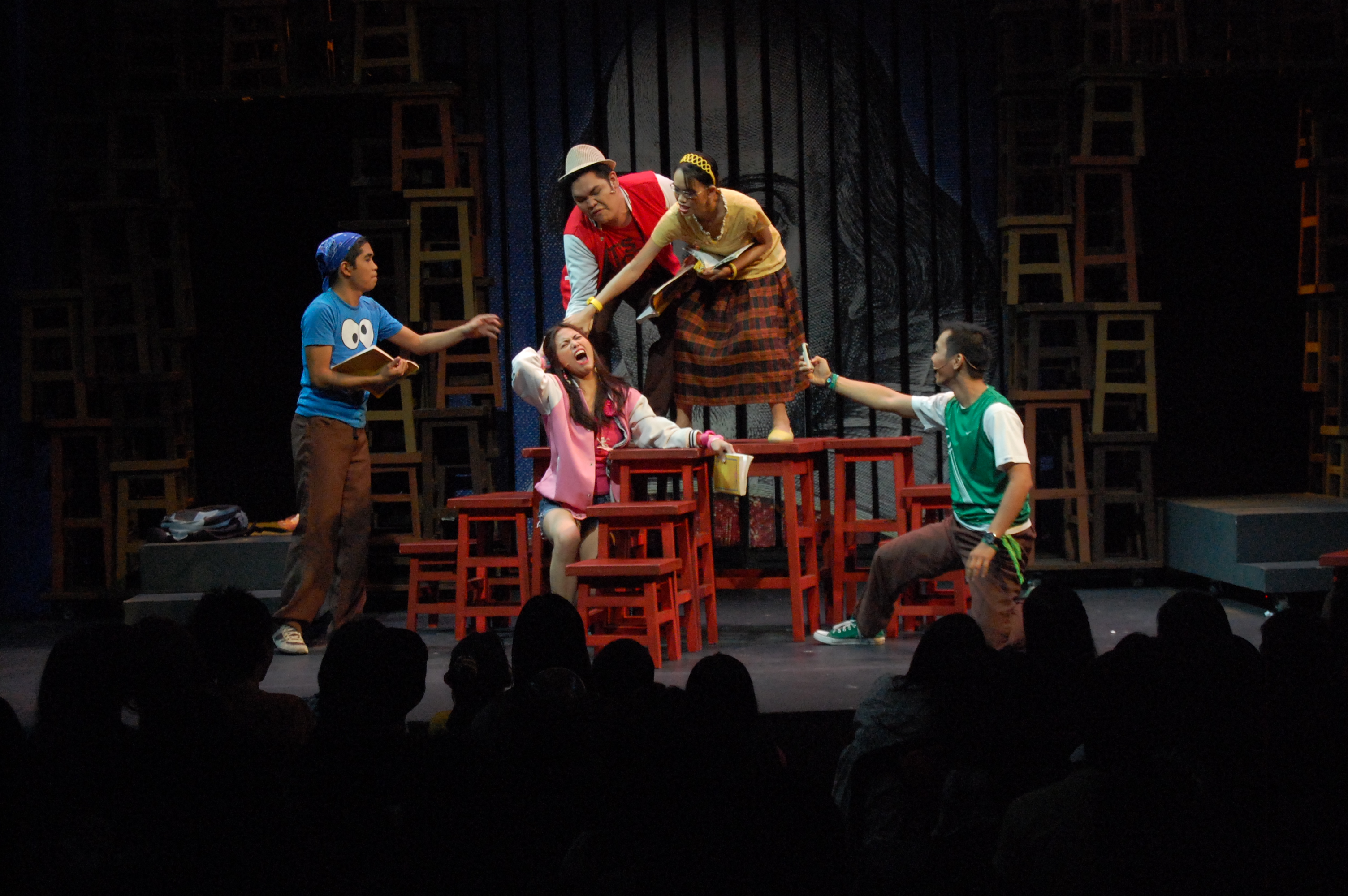
William, a play that was much reported and written about is an exciting revelation. Shakespeare has been done so many times, in innumerable ways, that it is rare to be surprised by just another interpretation. But that’s just it,William, is not just another interpretation. Rap, hip-hop and flip-top are the dominating forms, but these are seamlessly combined with Shakespearean plots, that an unaware audience might not notice. This is a gem for the Bard’s fans, as the stories and references unfold right before their eyes. William spoke, both to the high schoolers that needed a Shakespeare 101 and to Shakespeare aficionados in the audience; no one was left out, there is something for everyone.
Filipino life and Shakespeare? Yes, definitely. William, both the bard and PETA’S play is anything but predictable. Who would have expected that Shylock’s monologue from The Merchant of Venice, could help express the sentiments of Richard Austria, a gay teenager who is newly “out” in society? Or that Claudius’ guilt from Hamlet would translate into the jock, TJ Domingo’s guilt for “outing” his friend Richard and his sufferings from his abusive father? Another surprise is the appropriation of Marc Anthony‘s famous speech for the campaign of the push-over nerd, Erwin Castro, as he also tries to redeem is gay friend Richard. Famous monologues from famous plays appropriated in unique ways to reflect issues from the Filipino teenage life.
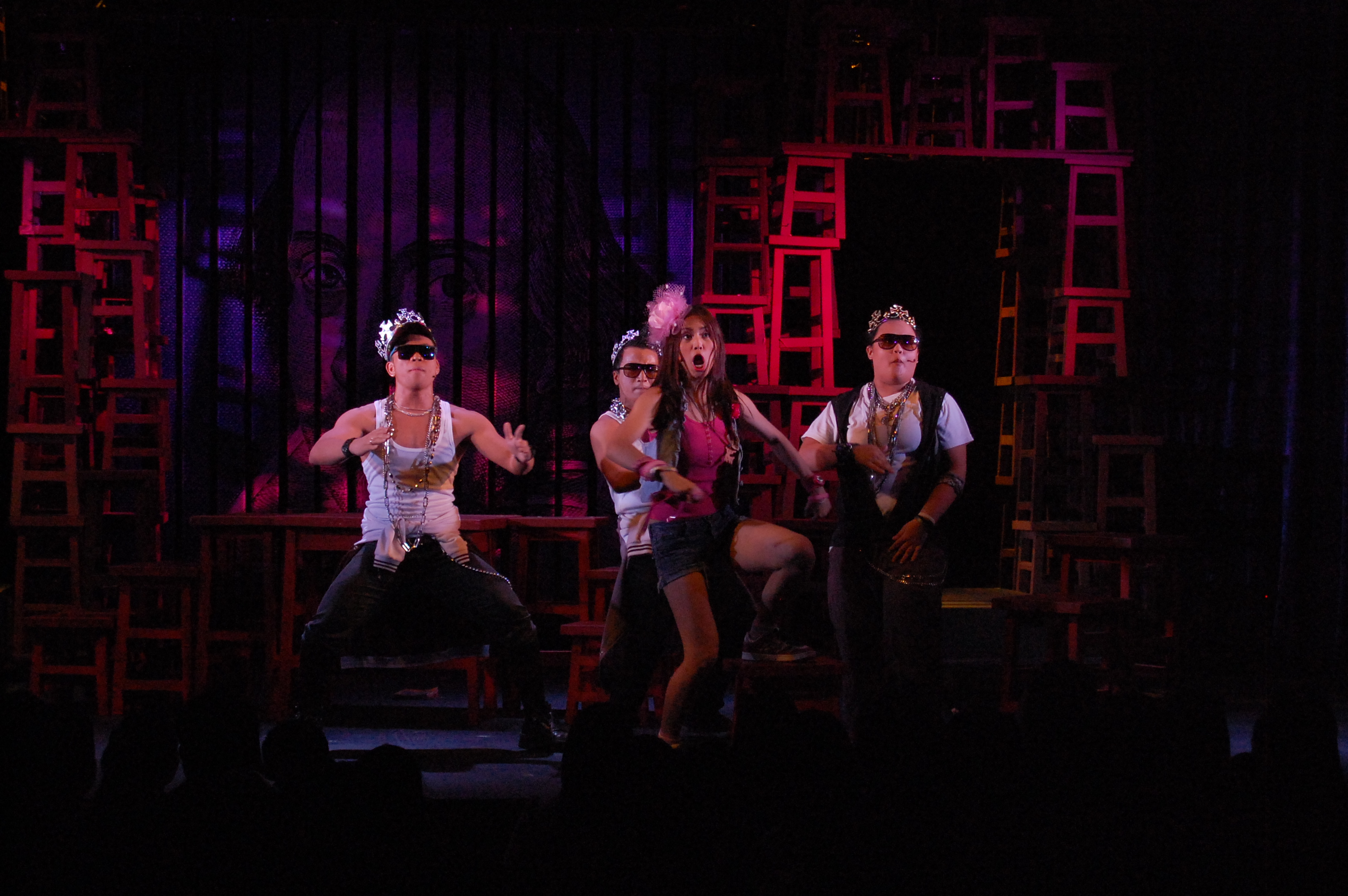
Easy to miss but jewels when you catch them are plot references from Shakespeare’s famous plays. The main love plot is very reminiscent of A Midsummer Night’s Dream as two pairs of couples find each other through the help of fate. The play also ended in a party, A Midsummer Night’s Prom that tied down the play neatly, as well as reflecting teenage life. Everyone ended up with their respective partners in the end. Also, the play will not be perfect without its mean, yet lovable, hip-hopping villains. Again, easy to miss, is its reference to the the three witches of Macbeth. Bugoy, Buchoy and Strawberry are the villains that would tie-up or open-up a scene with their hip-hop and flip-top. These three love making fun out of everyone, especially of the nerd, Erwin and the newly-”out” gay, Richard.
One memorable song is a hip-hop rendition of What’s in a name? Instead of the typical love story of Romeo and Juliet, the play focused on Juliet alone, and not in finding romance. Instead, Juliet finds herself, independent of any Romeo. Sophia Reyes, the Juliet of the group, started out as a nouveau riche, love struck teenager. She grew up and grew to love herself, embracing her romantic Juliet but going beyond the romance and reaching a transformed independent Juliet, who loves her own name, her heritage and even her countryside accent.
William, surprisingly, for a play meant for high students, also delivers a very strong position against gender discrimination. Though set in high school, without any overt sexual connotations, the play dealt with gender positions, again, very reminiscent of the Bard’s style. Mentioned before are the frustrations of Richard in a high school setting as he is bullied by his classmates because of his gender. The usage of some Shakespearean characters, though could be a bit anti-lesbian on some parts, still challenges traditional gender roles of society, just as the Bard did in his own time. Portia’s cross-dressing to defend Basanio from Shylock in The Merchant of Venice as well as Viola’s story in Twelfth Night were referenced as the characters look into their own gender positions. Though the term lesbian was thrown about in a bit unflattering tone, the basic message against gender discrimination cannot be missed.
The role of Shakespeare in education is very important for everyone. The very core of the play is education, and educate it does. Ms. Martinez, the weird and theatrical teacher struggles to bring Shakespeare to her students. From the boring and incomprehensible iambic pentameter, she shows her audience how Shakespeare can be made relevant to everyday life. The play itself shows how valuable Shakespeare can be in the analysis of Filipino life. The Bard, crosses language and nation as his works are interpreted and made relevant to everyday life. At the end, everyone is infected with “Shakespearitis” and every event in their life is referenced to the Bard’s work. Its an eye-opening transformation for everyone.
It is a rare event, that I can experience laughter and cheers in a small, intimate theatre, filled with high school students and a few adults and aficionados. The audience, clapped and reacted at almost every scene. They gave a number of “awww”s for romantic moments and even dead silence during the heavy monologues. The applause in the finale must have been heart-warming for everyone, especially coming from students that rarely reads Shakespeare in the contemporary technological world.
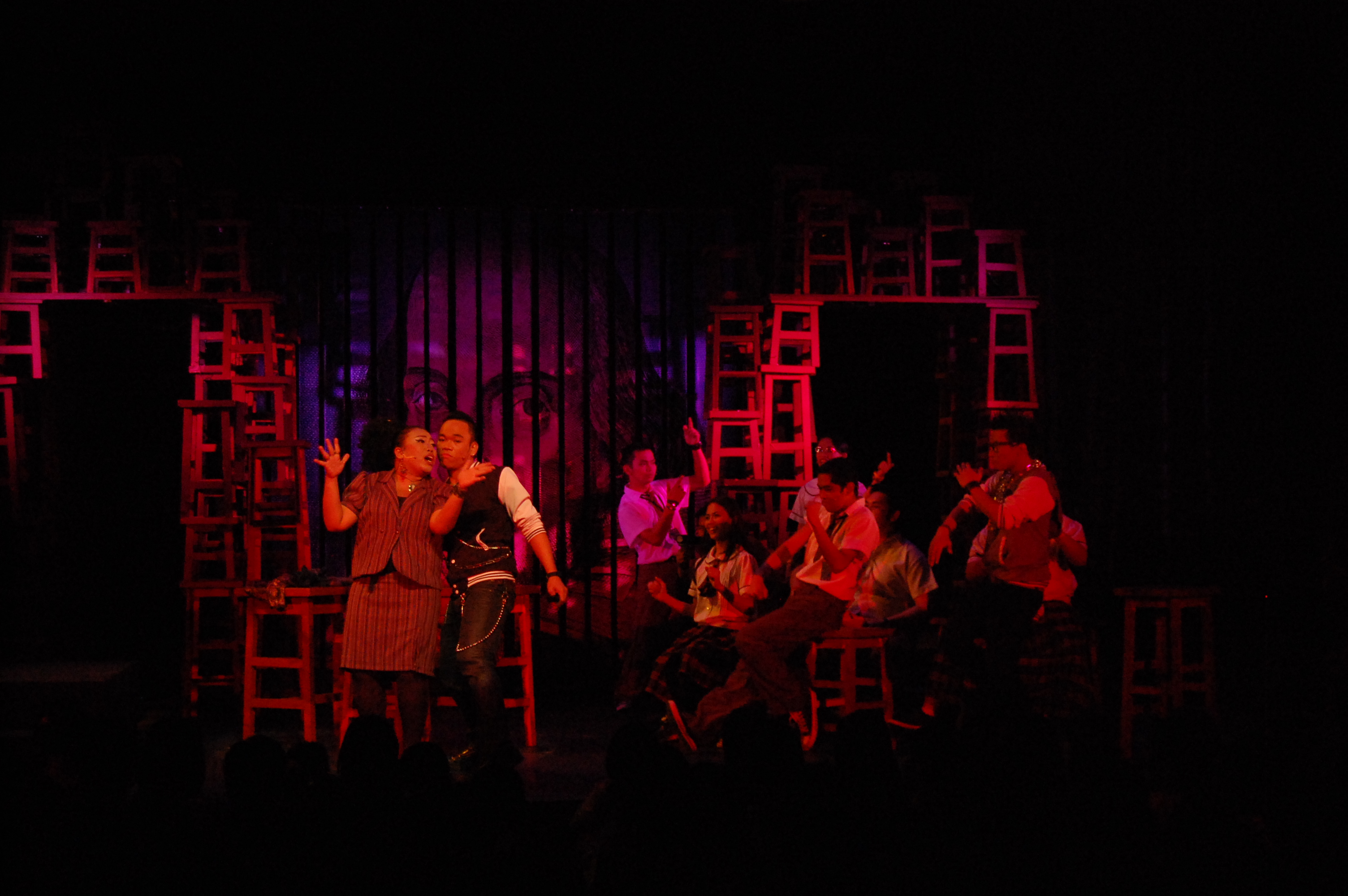
Transformation. As the background changes into a pop-art version of Shakespeare’s portrait, the finale wraps up William in another hip-hop song. Mostly, in the Filipino language, it expresses the relevance of the Bard in everyday life, and how much the youth of today can still learn from him. The Shakespearean topic has not been exhausted, even after all this time. PETA’s William is a proof of that. Shakespeare is relevant to students, teachers, theatre fans and practically everyone. If you look close enough, you can find William in your everyday life and, yourself, reminiscent of Shakespearean characters.
Once again, I am staring at a blank sheet of paper as I struggle with the topic I am working on–psychoanalysis and phenomenology. Neither of the two are my favorite. I certainly do not want to unearth the writings of Sigmund Freud and Carl Jung, again. As an undergrad, encountering their perception of the world for the first time, I was very impressed. I found it fascinating to read. I was opening the world of psychoanalysis, something I have never encountered before. Familiar, in a way, of the story of Oedipus, and having Oedipus Rex as the first play I have watched by Dulaang UP, I was enthralled. I thought it was a viable theory and even fooled myself into believing that it was an explanation for sexuality, behavior and representation. I had feminist leanings as a teenager as well, so encountering Laura Mulvey‘s Visual Pleasure and Narrative Cinema was a revelation. I found myself writing more and more about psychoanalysis and visual perception, I even remember my paper on the image-formation of Filipino women in cinema using Mulvey’s paper as a theoretical framework. Fortunately, I outgrew that perception of the world.
As I grew up and grew more critical of what I am reading and writing, I find psychoanalytic theories too encompassing, without consideration for other people and other cultures. Certainly, not everyone in the world can be the same? As fascination for a new concept fades and criticality begins, Freud’s Oedipus Complex and Jung’s Electra Complex became more and more ridiculous. I now find the concept of a son hating his father and desiring his mother, and a daughter hating her mother and desiring her father, in the way of their psychosexual development, absurd. Of course, in time, I knew that various points of their arguments were also disproved. The five stages of psychosexual development is no longer accepted. Yet, these are the starting point in the discussion of psychoanalysis. Certain theoreticians still adapt and appropriate these theories in their analysis. It is also a good beginning in the discussion of consciousness, particularly of the concept of the sub-conscious. Still, I struggle with the fact that, I just don’t want to write about this again.
I watched PETA’s production of William last Saturday. I have to say that its a very good play, a combination of Shakespeare 101 for students and ‘identify the reference’ for Shakespeare fans. Its a different feeling when you get to witness a theatre-full of teenagers laugh and applaud a Shakespeare-inspired play. Looking at this from a psychoanalytical point of view, the play could go down the road of over-reading and absurdity. There are various parent-child relationships in the play, notable ones are the relationship of TJ Domingo and Estella Marie Carandang. Their relationship with their fathers (played by the same actor but with different characterizations) display more or less the Oedipal and Electra Complexes. TJ Domingo, the rebel, aggressive jock has a violent relationship with his father. His father, a dominant and aggressive man is abusive and tends to beat-up TJ, whenever TJ fucks up. TJ of course, resents his father. The absent mother is never mentioned, but he looks into Estella, the mature mother-image of the group, to help him out whenever he was in a bind. He also grew to love her in a romantic way. Sounds familiar? Looking into Estella’s parental relationship, on the other hand, she resents her mother greatly for leaving them and is very close to her father as a result. The father tends to be over-protective of Estella and Estella adores him greatly. Again, familiar right? So, maybe Laura Mulvey wasn’t too far off in her essay, even though the narrative here is in theatre form. If my main focus is on the psychoanalytic aspect of the play, it would focus in these two parent-child relationships and its representation. There are two other characters with fathers (again played the same actor) with the same dynamics. A little bit different, though, is Erwin Castro’s relationship with his father. Even though he is male, he has a good and gentle relationship with his father. But the thing is, though Erwin is not gay, he is, in a way, effeminate. He is very gentle and soft-spoken, almost the common characterization of a woman. He is not aggressive, so there is no competition for dominance or for being the alpha male of the family, unlike in TJ’s case. Here, there is no struggle for power. Erwin, to a certain point, is a mediocre push-over. Using the psychoanalytic perspective will go far in any narrative, but I have grown up enough to know that it is often not enough, that there is something more to the perception of the world than psychosexual and power relationships of gender and consciousness. Or more to the point of psychoanalysis—the sub-conscious. Though this theory does not lack in merit, I still feel that there is something else, something more.
This is where I see phenomenology coming in. Instead of just focusing on the universal sub-conscious that psychoanalysis seem to imply, I want to explore art as we experience them. I want to point out the self-consciousness of the audience rather than the psychoanalytical dispositions and secret sexual desires that the audience apparently has no control over. Looking into Merleau-Ponty, when we perceive something, we also perceive ourselves, that we are also visible. He says that, “The visible can… fill and occupy me only because I who see it do not see it from the midst of nothingness, but from the midst of itself; I the seer am also visible. What makes the weight, the thickness, the flesh of each color, of each sound, of each tacile texture, of the present, and of the world, is the fact that he who grasps them feels himself emerge from them by a sort of coiling up or redoubling, fundamentally homogenous with them, he feels that he is the sensible itself coming to itself” (113-14). When you watch a play, you do not just see the play, you also locate yourself in the play. Part the popularity of William is the easy self-identification with at least one of the characters and recognizing other characters as someone one have encountered in everyday life. Very suited to the teenagers as the characters are mostly teenagers themselves, most adults can also relate as they have played such roles earlier in their lives. Often, the tendency is to relate to one character and remember people encountered in life that embodies the other characters.
There were five main characters in the play, the five students–TJ Domingo, the popular, basketball player, jock; Sophia Reyes, the nouveau riche, social climbing, beautiful, shallow, romantic girl; Richard Austria, the gay guy “outed” during the course of the play; Erwin Castro, the mediocre, push-over, quiet-type geek; and Estella Marie Carandang, the plain-looking, know-it-all nerd. These are the five stereotypes of the typical high school classroom translated into students learning about Shakespeare from their weird, passionate teacher Ms. Lutgarda Martinez. When viewing these characters, it is not a simple identification of the high school stereotypes but also self-identification with previous experiences informing and affecting the perception of the play. Paul Crowther further explores Merleau-Ponty:
“There are two aspects to this (though Merleau-Ponty does not always clearly separate them). First, as we have seen, things define themselves as styles brought about by our body’s modes of orientation towards the world. Our perceptual contact with the world is expressive, in so far as the body is constantly taking up new positions and launching itself into new projects. This means that the stylizing and expressive foundation of perception is of general validity. Each human has the same broad range of bodily capacities and will, therefore, tend to see and do much the same things (i.e. share the same styles of perception) as other human beings. However, it is also true that as individual embodied beings we each retain our particular view of the world” (108).
Aside from recognizing the Shakespearean motifs in William, the audience also recognize themselves as they experience the play. As Merleau-Ponty says in Eye and Mind, ” Things have an internal equivalent in me; they arouse in me a carnal formula of their presence. Why shouldn’t these (correspondences) in their turn give rise to some (external) visible shape in which anyone else recognize those motifs which support his own inspection of the world” (60). There are several layers of recognition that may happen. At first, the easiest one is the characterization of the high school stereotype that an audience may relate to. Next, is the Shakespearean references that such characters represent. Another layer is the Shakespearean play or sonnet that the character is acting out, whether straight-up recitation (Shylock’s monologue from The Merchant of Venice) or appropriated to a more Filipino context (Marc Anthony’s monologue from Marc Anthony and Cleopatra). Yet another layer that may affect this identification is the actual knowledge or experience the audience have of Shakespeare. Though some are easy to identify as it is explicitly stated in the performance, some are not, and only those who have some previous readings and knowledge of Shakespeare may recognize. Such identifications may happen in different layers within the embodiment of the play. Each person will have a different sense and layer of such embodiment. A necessary condition for such embodiment, is self-consciousness, as Crowther defines it, “To be self-conscious is to be able to ascribe experiences to oneself. It is to be a person” (150). In order to examine the consciousness and embodiment present in William, I want to go beyond the consciousness and sub-consciousness of Freud and consider the phenomenological proposition of Crowther in Art and Embodiment, from aesthetics to self-consciousness:
“The first of these I shall call attention. By this I mean our capacity to be receptive to sensory stimuli. It is a basic orientation or directness bound up with our body’s position in relation to that world of sensible items and events with which it is causally continuous. The second necessary capacity is that of comprehension. A self-conscious being in one who must be able to organize the stimuli received in perception by discriminating sameness and difference amongst them. This capacity is powerfully enhanced by the third necessary (and complex) feature, which I shall call projection. A being can only be self-conscious if it can posit situations other than those presented by the immediate perceptual field. The chief projective powers are memory and imagination; the former enables us to posit situations in which we have previously been, and the latter enables us to posit alternative possibilities of experience to those which are immediately accessible to us in perceptual terms. The projective powers, of course, are the very flesh of any sense of having a personal history” (150-51).
I will take into consideration, the most powerful performance delivered in William, the character of Richard Austria, the gay guy. His story embodies Shakespeare’s Shylock, the Jew from The Merchant of Venice. Richard was a closeted gay, “out” only to his closest friends. A fight with TJ caused him to be “outed” in his entire school, resulting to his persecution. Richard, the hard-working class representative was suddenly mistreated and harassed by his fellow classmates. Thus, he delivered Shylock’s speech, as they both embodied persecution, “He hath disgraced me, and hindered me half a million, laughed at my losses, mocked at my gains, scorned my nation, thwarted my bargains, cooled my friends, heated mine enemies; and what’s his reason? I am a Jew. Hath not a Jew eyes? Hath not a Jew hands, organs, dimensions, senses, affections, passions? Fed with the same food, hurt with the same weapons, subject to the same means, warmed and cooled by the same winter and summer, as a Christian is? If you prick us, do we not bleed? If you tickle us, do we not laugh? If you poison us, do we not die? And if you wrong us, shall we not revenge? If we are like you in the rest, we will resemble you in that. If a Jew wrong a Christian, what is his humility? Revenge. If a Christian wrong a Jew, what should his sufferance be by Christian example? Why, revenge. The villainy you teach me I will execute, and it shall go hard but I will better the instruction” (Act III, Scene 1).
In the manner of Crowther’s self-consciousness, the layers are attention, comprehension and projection. In Richard’s arch and almost every other performance, the most obvious part in experiencing it is by paying attention, in order to be receptive of the performance. Next is to organize the stimuli received and basically understand the performance–what is happening, why it is happening, what are the the Shakespearean references made, what is the plot, what does the plot pertain to in Shakespearean plays, etc. But the most notable part in Crowther’s self-consciousness is projection, the actual embodiment. The relationship of Richard’s character and performance and the memory or imagination of the audience will come in to play. Do you need to be gay to be able to feel for or project the performance of Richard’s character? Not necessarily. Because even though you do not have the memory of being a discriminated gay student, you still have the memory of others as well as your own imagination that enables you to project yourself into the performance. Through an effective performance, one can project the self into it through memories and imagination–feel the frustration, the pain of betrayal, the hate of discrimination and the release into freedom after the resolution. The phenomenology in experiencing and projecting into a performance could be achieved in that manner. This projection will also have another layer, as the audience will not only project themselves into Richard, but also into Shylock as he is embodied by Richard. The pain of persecution and the desire for revenge is something that would be powerful in the memory and imagination of the audience. The layers of embodiment enriches each other, as the character (Richard), the character reference (Shylock) and the audience affect each other and enrich each other in the phenomenological and aesthetic experience, and transcend this relationship into the projection of the self.
Another interesting character is TJ. He is initially presented as a stupid jock, a bully and a villain. As the narrative goes further, he was humanized as his relationship with his father was explored. He was also redeemed towards the end as he apologized publicly to Richard. Again, looking at it from Crowther’s self-consciousness and embodiment, one does not necessarily need be in TJ’s situation or have a memory of experiencing such event. The imagination of the audience will help transcend the performance from attention and comprehension, well into projection. With such imagination, the audience may project on to the humanization of TJ, his reasons for being a bully, his eventual redemption. The viewer may not only comprehend the meaning of redemption but also characterize and embody the feeling of being redeemed. This gives the ephemeral character of a performance lasts in the imagination of the audience. Just like in Richard and Shylock, the layers of embodiment is also there. This time, the relationship is between TJ, Claudius and the audience. One does not necessarily be a betrayer to feel the pain of betrayal. The use and enhancement of memory and imagination will come into play as the humanization and pain of the villain is represented. The viewer transcends into the character of TJ and into the the character of Claudius from Shakespeare’s Hamlet:
“O, my offence is rank it smells to heaven;
It hath the primal eldest curse upon’t,
A brother’s murder. Pray can I not,
Though inclination be as sharp as will:
My stronger guilt defeats my strong intent;
And, like a man to double business bound,
I stand in pause where I shall first begin,
And both neglect. What if this cursed hand
Were thicker than itself with brother’s blood,
Is there not rain enough in the sweet heavens
To wash it white as snow? Whereto serves mercy
But to confront the visage of offence?
And what’s in prayer but this two-fold force,
To be forestalled ere we come to fall,
Or pardon’d being down? Then I’ll look up;
My fault is past. But, O, what form of prayer
Can serve my turn? ‘Forgive me my foul murder’?
That cannot be; since I am still possess’d
Of those effects for which I did the murder,
My crown, mine own ambition and my queen.
May one be pardon’d and retain the offence?
In the corrupted currents of this world
Offence’s gilded hand may shove by justice,
And oft ’tis seen the wicked prize itself
Buys out the law: but ’tis not so above;
There is no shuffling, there the action lies
In his true nature; and we ourselves compell’d,
Even to the teeth and forehead of our faults,
To give in evidence. What then? what rests?
Try what repentance can: what can it not?
Yet what can it when one can not repent?
O wretched state! O bosom black as death!
O limed soul, that, struggling to be free,
Art more engaged! Help, angels! Make assay!
Bow, stubborn knees; and, heart with strings of steel,
Be soft as sinews of the newborn babe! All may be well.”
(Act 1, Scene 3)
This is the aspect that William does well in terms of engaging the audience. The main intention of the play is to enrich the knowledge of the audience, particularly the high school students, of Shakespeare. They do this, phenomenologically. The audience are given so many layers in the engagement, depending on the depth of their self-consciousness. As mentioned earlier, the easiest to identify with is the high school students. At one point or another in the audience’s high school and teenage life, they embodied a form of these stereotypes. Next is the embodiment of the character of another characters, those of Shakespeare’s. They transcend space and time as they bring to life characters hundreds of years old and embody them in their characters. The audience then, is given another layer of story and characterization to project themselves into. While all these is going on, the audience are projecting both their memories and imagination into the complexities of the characters performing. These workings on the aesthetic experience and the embodiment of the self into the artistic production enriches the performance as well as the viewing of the performance. It does not work in one way. There is the interchange of the phenomenological experiences between the audience and the performers as they project their own uniques selves—previous experiences, memories and imagination, into each other.
This dynamics in the art, not just in the theatrical performance, needs to be further explored, rather that being stuck in the rut of the sub-conscious. The theory of the sub-conscious, at least for me, is imaginative, too imaginative that the theory robs the imagination from the audience and the viewer. It is in the psychological couch that all imaginations are sucked in, never to be shared into the world. Self-consciousness, on the other hand, is far richer than the sub-conscious that the conscious realm cannot control. Self-consciousness, at least can be enriched. A person, through their own choosing, may enrich their own experiences, dig deeper into their memories and use their creative imagination as they experience things around them—particularly art, such as the theater. It has become so easy to rely into more “scientific” theories that the realm of imagination has become limited. The audience have the option, the choice, in using their memories and imagination—they become the proactive actors, rather than being mere victims of the psychosexual development and sub-conscious desires. Self-consciousness and the embodiment of aesthetics may evolve, develop and may enrich—it does not limit a passive recipient. Instead, aesthetic embodiment, in a phenomenological sense, may enrich, both the audience and the performance. It is a consistent transcendence of memories and more importantly, of the imagination. It is not just the artist who may imagine, but the audience and the viewer as well.
References:
Crowther, Paul. Art and Embodiment, From Aesthetics to Self-Consciousness. New York: Oxford University Press, 1993.
Legarda, Maribel, dir. William. Philippine Educational Theater Association, September 2011.
Merleau-Ponty, Maurice. The Phenomenology of Perception trans. Colin Smith with revisions by Forrest Williams. London: Routledge & Kegan Paul, 1974.
Merleau-Ponty, Maurice. The Visible and the Invisible trans. Alphonse Lingis. Evanston: North-western University Press, 1968.
Mulvey, Laura. “Visual Pleasure and Narrative Cinema,” A Critical and Cultural Theory Reader, ed. Terry Eagleton, 1985. 158-166.
Shakespeare, William, Hamlet. New York: Barnes and Noble Books, 2008.
Shakespeare, William, The Merchant of Venice. New York: Barnes and Noble Books, 2008.
So, given all the oddities I stumbled into last week, I decided to continue on stumbling into odd and otherwise tidbits again this week.
If Shakespeare is called by any other name, would he still be Shakespeare? Would our favorites, such as Merchant of Venice and Romeo and Juliet, and Midsummer Night’s Dreambe the same, if they were written, not by the now familiar bard, but someone else? Steven Cherry hashes out this issue as he reminds in Shakespeare by Any Other Namethat the Shakespeare authorship is still under debate. Would it be a very different world, if Shakespeare is not the Shakespeare that we have always believed to be?
Few people earn from the Bard, few people earn from Shakespeare. Even staff of The Shakespeare Standard does not earn from the Bard. David Sabrio, states, “Reading and studying Shakespeare, the arts and humanities may not make us materially wealthy. But studying these fields can give us wealth that is not subject to the fluctuations of the Dow Jones averages; the arts, humanities, and Shakespeare give us wealth that, in the long run, is just as valuable as material goods and far less ephemeral. We should not have to choose between Shakespeare and solar shingles.” In the article Either or Fallacy: Shakespeare vs. Science, the Bard’s importance to our everyday life was given life, though we may not earn from it.
Photo by Ian Nichols
Shakespeare is an inspiration to literature, in so many levels. This includes the inspiration for Shakespeare and Company, a quaint bookstore that “lives under the brooding glory of Notre Dame de Paris, at 37 Rue Bucherie, in the fifth arrondissement.” According to Ian Nichols, “To walk into Shakespeare and Co is to enter a wonderland jumble of books. The first thing you see upon entering is a case holding rare books and first editions. I had to have my credit card surgically removed when I saw a first edition of Hemingway’s The Sun Also Rises on display.” The book stops here, “There may be some order to how the books are stacked, piled and heaped, but it is one open only to initiates. For the novice, it is simply a browser’s paradise, where you can grab a book of poetry, slide on up to one of the many cafes nearby and enjoy a little verse and execrable French coffee. If you’re lucky, you may chance upon on of their weekly readings, a signing, or even one of their bi-annual festivals. Like Paris, Shakespeare and Company is a whirlwind of delights.” As the inspiration suggests, Shakespeare has his unique pleasure that you have to find amidst the whirlwind.
Stewart Buettner, Author of The Shakespeare Manuscript
More on Shakespearean inspired literature, a literature from literature, Lauren Zachary reviews Stewart Buettner’s The Shakespeare Manuscript, “The race to put on the new production is on, but this strange new Shakespearean play takes its toll on everyone involved as they search for the manuscript and begin to discover their true identities, revealing secrets and taking risks along the way. Was the manuscript really written by Shakespeare? Or is it a fraud? And who stole the manuscript? The Shakespeare Manuscript is an interesting read as Buettner weaves this captivating plot by providing a perspective of a different character with each new chapter. This keeps the reader on edge and speculating as to who stole the manuscript until the very end. It does contains a fair amount of foul language and material that may make it difficult to finish.”
On a lighter note, can you imagine Shakespeare’s Macbeth voice-acted by The Simpsonscharacters? Jack Van Beynen says, “Some of the play’s funniest moments came when he played on the original text, inserting pop culture references or snide remarks from the characters pointing out its flaws. Although he takes many liberties with the script, this is the show’s beauty. Miller proves that Shakespeare can be fun, that we can play with it as well as revere it.You get the sense Miller really loves Shakespeare, and while The Bard can seem daunting, MacHomer is an excellent, highly entertaining way of making one of his greatest tragedies accessible.”
Literature and more, we should open more caskets and discover more Shakespeare. If you pay attention, he is around and easy to stumble into. How did you stumble into Shakespeare today?
Are you interested in joiningThe Standard’s volunteer staff? Check out our current staffing needs. If one of our roles sounds perfect for you, email our Managing Editor today!
Choices. Remember the Choose your own Adventure books? Well, now we have choose your own ending. Imagine if Romeo decides to go back to Rosaline instead of going after Juliet, will he have a happy ending then? Which will you choose, a powerful but tragic ending with Juliet, or a simple, happy and contented marriage with Rosaline? Though the re-interpretation received mixed reviews, it may be interesting to wonder the “what ifs” of the Bard.
What ifs. What if you experience Twelfth Night steampunk style? Ironically sponsored by Bronxville Women’s Club, Pipe Dream marries the conflicting industrial and Victorian styles, even adding a touch of western air. Carla Young says that “Actors performed on a sparse set, which included only a couple of chairs and a small table, and were illuminated by subdued decorative lights wrapped around a number of trees in the courtyard of the Women’s Club. The evening’s biggest round of laughter was awarded to ‘Malvolio,’ who despite the despair caused to him by fake love notes purported to be from Olivia, was an audience favorite throughout the show.”
Rap, hip hop and soul. Shakespeare as the original rapper?PETA (Philippine Educational Theater Association, “noted that just like today’s rap hits, Shakespeare’s works are based on beats, rhythm and rhyme. ” The play, “William features 10 original rap songs composed by Jeff Hernandez which are a mix of various genres such as rock, soul, funk, RnB and hip-hop. It also utilizes FlipTop, a form of rap that is becoming more popular among today’s Filipino youth.”
Naked Bard. The oddities continue. If Shakespeare is deemed boring by some, imagine if his play are recited by girls. Beautiful, sexy and naked girls. New York’s Greenwich Village houses the Naked Girls Readinggroup. In an intimate, boudoir-type room, wine is sipped, literature is read and a “full frontal literature” is delivered. Sapphire Jones, a member of the cast, prompted strong emotions upon dedicating a Shakespearean text to her grandmother. The burlesque-inspired literary performance also reads from Wilde’s The Importance of Being Earnest and Ibsen’s A Doll House.
Classes. Surprising, or oddly enough, lot of students are still interested in Shakespeare today (despite the lack of naked girls). Sometimes, they are inspired by a brilliant mentor. Professor Dennis Huston’s Shakespeare on Film, is only offered once every two years and is very popular among the student. He practices Socratic-style discussions as well as delivers powerful lectures. This is enough to inspire student to enroll in a 7:30 am class and discuss about Shakespeare. The end of the term also results in the class’ own Shakespearean performance.
Oddities. There are a lot of oddities in the Shakespearean world. Its not always the straight, formal, Elizabethan theme that pervades the ordinary imagination. It is for all people, of various shapes and sizes, in every way possible, even in the oddest of the odd voices. Let’s admit it, sometimes, its even more interesting that way, the odd way.
What other odd voices have you seen or heard of the bard today?
Are you interested in joiningThe Standard’s volunteer staff? Check out our current staffing needs. If one of our roles sounds perfect for you, email our Managing Editor today!
Looking, searching, and many times, just stumbling.
Sometimes, you don’t have to look too hard to find Shakespeare. You’d be surprised; Shakespeare will just come and find you.
Ty Cacek/The New York Times. Underground theatre: Paul Marino, with beard, and Fred Jones perform a scene from “King Lear” in the subway.
Lead Subway. Do not be afraid if you suddenly find two guys screaming scenes from Romeo and Juliet on the New York Subway, no, they are not insane; yes, it is illegal; and yes, they still do it anyway. Claudia La Rocco tells the story of Fred Jones and Paul Marino as they create an underground theater and perform Shakespearean plays such as Romeo and Juliet and Hamlet. Bringing theatre to the people was exhausting work but has become their main source of income, aside from the much applause. They let their voices be heard from the underground, reminding people of the bard and his plays. No, you don’t need to spend too much money, or any really, to enjoy Shakespeare.
Golden Casket. Inspiring as Jones’ and Marino’s stories are, some theatres are suffering some financial cut backs according to Misha Berson. Though Shakespearean plays, such as those by Oregon Shakespeare Festival are spared from such difficulties, it is still a major issue in the theatrical world. Berson writes, “If theater is, as Shakespeare declared, a mirror held up to nature, wouldn’t it be grand to not just see a few faces reflected in the glass — but sometimes, also, a crowd? Yes, in this financial winter of our discontent, it seems like a distant dream for any playwright to dare that. But artists should always be encouraged to dream big.” Now, if only it is as simple as selling that golden casket to provide financial backing…
Lottery. Though money is not always the problem for some, “Neither a borrower, nor a lender be.” Maybe we can just find more things for free? Just like Portia’s lottery of a love life, lucky ones can avail of tickets for Shakespeare Theatre Company’s free performances for Julius Caesar. As traditionally practiced since 1991, they give free performances to the public once a year. Tickets can be availed via an online lottery or by simply arriving early, as there are 200 tickets reserved for the standby line. More public Shakespeare, whether on the underground, the streets, the park and even in the comfort of the theatre; the bard is becoming a part of our everyday life more and more, and you don’t even have to worry about the costs, just don’t forget to pay with applause.
Of lead dreams and successes. We can always start with dreaming big, and then we can be very surprised to what it can bring us. Oregon Shakespeare Festival celebrates their 75th Anniversary with WillFul, named after and inspired by the bard, it is “a different sort of theatrical creature. Instead of sitting and watching it in one of the festival’s comfortable theaters, audiences will take a journey, moving from place to place, watching scenes unfold in a park, on a loading dock, on the stairwell of a parking garage. And though the actors are working from a script and telling a story, the show’s method — and its goal — is less about delivering a narrative than shaping a communal experience.” I wonder how much Shakespeare would enjoy a new interpretation of theatre rooting from his own innovations and bringing it closer to the people.
Alla Dreyvitser/The Washington Post
Interpretations. Is there a right or wrong interpretation? To cut or not to cut, that is the question.The Washington Post explores that very debate. Is it really better to cut in modern Shakespearean for more understandable interpretations? Or do we need everything so we can fully appreciate Shakespeare? What would bring it closer to the people? On the other hand, would the meaning be lost because of the cuts? The article cites, “If you can’t follow at all why something’s funny, then I’m going to cut it,” Posner says, “because I’m not interested in the theory of why it’s funny.”
Tragedies. Alexa Rae Smahls reports that UCLA students in Shakespeare travel study program unaffected by London riots. Meanwhile, Sylvia Morrisprovides Shakespearean reading on the London Riots as she sees Richard III in Bill Bratton’s statement, “In a country that loves gardening, you fully appreciate the idea if you don’t weed a garden, that garden is going to be destroyed – the weeds are going to overrun it. Similarly for social disorder: if you don’t deal with those minor crimes, they’re going to grow. What also grows is fear, the most destructive element in any civilised society.”
Why should we …
Keep law and form and due proportion,
Showing as in a model our firm estate,
When our sea-walled garden, the whole land,
Is full of weeds, her fairest flowers choked up,
Her fruit trees all unpruned, her hedges, ruined,
Her knots disordered, and her wholesome herbs
Swarming with caterpillars.
Closed Casket. Some caskets deemed not to be opened. One of this is of the bard himself. Ojeme Usiahon, a Nigerian artist, expresses his opposition to the plans of exhuming Shakespeare from his tomb. The inscription on the tomb specifically states, “Good friends for Jesus sake forebear to dig the dust enclosed heare, blest be the man that spare the stone, cursed be he that moves my bones.” Usiahon argues that, “Though others have been wondering what difference it makes to the remains, since Shakespeare is already dead, someone even said will there have been any controversy if he weren’t so popular. But my great respect to this living legend is that could it be that their (scientists) purpose is to determine the value of his remains? Can the value of his remains outweigh any respect the world has for his epitaph and last wishes? Will the society allow his privacy, honor, and respect be dishonored? Will it affect over 200,000 tourists that visit the place of his baptism and burial?” I also have to agree with Usiahon, for once, this is one casket that should not be opened.
Are you interested in joiningThe Standard’s volunteer staff? Check out our current staffing needs. If one of our roles sounds perfect for you, email our Managing Editor today!
(This is a re-post from my weekly column at The Shakespeare Standard for Voices Wednesday. This was first published on August 10, 2011. See the orginal version here.)
Censorship. It is one of the worst things that can happen to an artist. It even happened to Shakespeare as he was censored during the Elizabethan times for some of his plays, “Jonson, Marlowe, Kyd and Shakespeare would all, to varying degrees, be brought to book for material they had written that was considered seditious. Kyd would be almost tortured to death for a misreading of his work, and it is possible that Marlowe’s typically outspoken verse was a component in his eventual murder.” Though Shakespeare would be a bit luckier, he came to numerous close calls throughout his lifetime. Even Othello, King Learand Macbeth face censorship in the modern to contemporary times.
I had a complete turnaround in writing today’s column. I was once again going to open some caskets of reviews, opinions and commentaries when I ran into some disturbing news here in the Philippines. Forgive me if this has a very personal note, but I know Shakespeare would understand because he suffered the same way. One of our artists, Mideo Cruz, is facing persecution under the church and the government, the exhibition he was part of was closed down, funding of the Cultural Center of the Philippines is threatened and its officials are being asked to step down. This especially reminded me of Shakespeare’s Sonnet 66:
Tired with all these, for restful death I cry,
As, to behold desert a beggar born,
And needy nothing trimm’d in jollity,
And purest faith unhappily forsworn,
And guilded honour shamefully misplaced,
And maiden virtue rudely strumpeted,
And right perfection wrongfully disgraced,
And strength by limping sway disabled, And art made tongue-tied by authority,
And folly doctor-like controlling skill,
And simple truth miscall’d simplicity,
And captive good attending captain ill:
Tired with all these, from these would I be gone,
Save that, to die, I leave my love alone.
“An art made tongue-tied by authority,” much like Shakespeare and his fellow playwrights were during their own time. Thankfully, though other artists still suffer such oppression, Shakespeare is more emancipated, if not completely free from censorship.
Indoors. Today, it is a great thing that Shakespeare is considered as a very freeing experience as seen in San Quentin Inmates who participated in Twelfth Night. Bay News City Service quoted Angel Alvarez, a man sentenced to life in prison, “We do this to keep our sanity. At least for me, I do it to keep my sanity.” It is very inspiring to see this kind of Shakespearean influence in contemporary life, “Laughter filled an auditorium in San Quentin State Prison on Friday afternoon as 13 inmates performed a musical version of Shakespeare’s comedy Twelfth Night for a crowded room of staff, guests and fellow prisoners.”
(Photo by Trish Gannon)
Outdoors. Shakespeare in the Parks, on the other hand, show how people can now experience Shakespeare in a way that he might have wanted it to be experienced, uninhibited, without any fear of oppression. Trish Gannon in They Say the Lady is Fair writes about the upcoming performance of Much Ado About Nothing on August 20 at the Heron ball field in Montana. She says that “Shakespeare in the Parks, it could be argued, is a Shakespeare experience in the way he himself intended it to be: live (complete with pauses, and sometimes laughter, when the evening train rolls through town) and unplugged. It’s an experience you won’t want to miss.”
Unbound. It is no longer, Queens, Kings or their retainers that will stop a Shakespearean performance, though chance can try. But as the old saying goes—the show must go on! TheOregon Shakespeare Festival made a makeshift The Bowmer in the Park after the Angus Bowmer Theatre closed due to a damaged ceiling beam. Their will to perform and bring Shakespeare to their audience is very admirable as they fight chance and a threat of financial loss. The show did go on, as Shakespearean plays will go on in the years to come.
Censorship of Shakespeare is still alive, but he is much freer now compared to his fellow artists. A lot of artists are still suffering from oppressive restrictions from the state, church and society. We should work on the emancipation of art all over the world. After all, had censorship succeeded, we would not have Shakespeare in our lives as we do now, and what a dull life that would have been. We should keep up the fight against censorship as Shakespeare did, as he continue to do still. Important as the caskets were, it would have been senseless, if they were never opened.
So again, as I say, let’s open the caskets and start the discourse—without fear or inhibition.
(This is a re-post from my weekly column at The Shakespeare Standard for Wednesday Voices. Originally published on August 3, 2011. See the original version and comments here.)
Hi! For my first column, I took inspiration from the awesome character of Merchant of Venice—Portia. My weekly columns, as I visualize it, will be like opening Portia’s caskets and finding opinions, commentaries and discussions about Shakespeare. I don’t have a degree in Early Drama like most of my colleagues here in The Shakespeare Standard but I have always been a fan of Shakespeare. This is a circumstance that a lot of you, readers can relate to. We need to engage more people in this aspect of the Elizabethan world that we love and enjoy. He should be a part of our everyday life and a topic of our everyday conversation.
The Golden Casket. The question of Shakespeare’s relevance to our world often comes up. Seeing Shakespeare through the glamorous golden casket often brings isolation and death. Such an instance is Murray Wardrop’s report that Jane Horrocks will no longer be doing Shakespearean play, “Jane Horrocks: Shakespeare is inaccessible.” After being required to urinate on-stage night after night during her performance for Macbeth, her statement is quite reasonable. Though she says it’s the pentameter, rather than the peeing, that she doesn’t understand. Personally, I think that’s an unnecessary loss in to the community. Shakespeare should engage us, not isolate. What can we do to prevent such deaths while spouting pentameters, preferably without public urination?
Use Lead. Theatre does not necessarily have to be shiny and sparkly. Open the lead casket and you might find something more interesting, like Anthony Stoeckert did when he discoveredPlays in the Park, Midsummer Meets Mardigras.William Bard is directing A Midsummer Night’s Dream with a Mardigras twist at the Pleasant Valley Park Amphitheatre in Bernards Township on July 29 to Aug 5. He says, “People bring blankets and sandwiches and their beach chairs and their bug spray. They come out and have a great night with their family. They’re introduced to William Shakespeare in many ways. It’s really a great community effort.”Getting the community to engage, more importantly, to enjoy Shakespeare is a great feat.
Stumbling into silver.Ben Brantley, on the other hand, unearthed a fools head on the Royal Shakespeare Company’s popular version of Merchant of Venice. He finds Rupert Goold’s version full of unnecessary razzle-dazzle and was deeply bothered by the Elvis, Batman and Robin costumes. Still, some commentators on the article find the show more acceptable than Brantley. One even states that it’s enjoyable. With two varying perspectives, the question arises, which is better, an Elizabethan adaptation that the Brantley’s of the world would approve of or familiar and localized adaptations such as those tried by Rupert Goold and William Bard? Will the community be misled by such adaptations? Or maybe, just maybe, it can make Shakespeare involved in their daily lives?
Gold, silver or lead, each casket had a purpose. The key concept here is engagement. What would make people talk about and even debate about Shakespeare? It’s not so much about appreciation but consideration. What can help people not dismiss the concept of Shakespeare? Can it be theatre? Or school? Or the community? Andrew Cowie opens a discussion on the question should Shakespeare be a required subject in school while Sylvia Morris presents Shakespeare in Cinema. There are a number of approaches the can be taken, or as I would love to say, a number of caskets that can be opened. Though one casket is better than the others,Merchant of Venice would’ve been bland and lifeless with just the lead casket.
Rainbow-coloured caskets. Shakespeare also influenced numerous movements and even language. Shakespearean discourse is engaged, not just in theatrical performances of his plays, but also in language, culture and reinterpretations. Harold Raley explores the relationship and impact of Shakespeare and the King James Bible on the modern English Language. Meanwhile, Emma Young discovers an indirect re-interpretation of Shakespeare in The Weird Sisters where his characters Rosalind, Bianca and Cordelia were given new life. Surprisingly, even Shakespeare is present in Dulaang UP’s Rizal X, a play about the re-introduction and re-interpretation of Philippine’s national hero. Pleasantly surprised when as early as Act 1 (Auditions), Shylock’s Jew from the Merchant of Venice was recited, pertaining to Rizal’s feeling of oppression.
Continue looking. I’ll keep my first column short, for now. I just had this discussion with a friend, “how can we popularize Shakespeare”? How can we get more people to read him, watch performances of his plays or make him a topic of everyday conversation? We are still at a loss for a true answer to that. Then, I got a positive e-mail from Jeremy, giving me a chance to engage readers of The Shakespeare Standard. I hope I do an alright job. I’d love to hear comments and feedbacks, so I can improve on what I do. First things first, let’s open up the caskets and start the discourse.
Points for Discussion: How can we include Shakespeare in our everyday conversations? What are his other influences in our everyday lives?
The Lead Casket—“Who chooseth me must give and hazard all he hath.”







 Portia Placino